A secure configuration management guide should not begin with a checklist of settings. It should begin with a harder operational question: which misconfigurations could interrupt a critical service, expose sensitive data or leave leadership unable to prove that controls are working?
That distinction matters. Most organisations already have policies, benchmarks and technical owners. The problem is that configuration assurance is often split across cloud consoles, endpoint tools, identity platforms, network devices and spreadsheets. Teams can see individual findings, but not the services affected, the owners accountable or the evidence an auditor will ask for.
Secure configuration management is therefore not simply a hardening exercise. It is a continuous assurance discipline: establish the intended state, identify drift, assess business impact, remediate with control, and retain evidence that the fix is real.
Why secure configuration fails in practice
Configuration weakness is rarely caused by a lack of standards. CIS Benchmarks, vendor guidance and internal security policies provide useful baselines. Failure usually occurs because the organisation cannot apply those standards consistently across an estate that is changing faster than manual review can keep up with.
A cloud administrator may alter a storage setting to resolve an urgent delivery issue. An inherited server may retain an obsolete local account. A privileged Microsoft 365 role may be assigned temporarily and never removed. A firewall rule may be broadened for a supplier connection, then become normal through neglect. Each change may look minor in isolation. Together, they create exposure that is difficult to detect and even harder to explain.
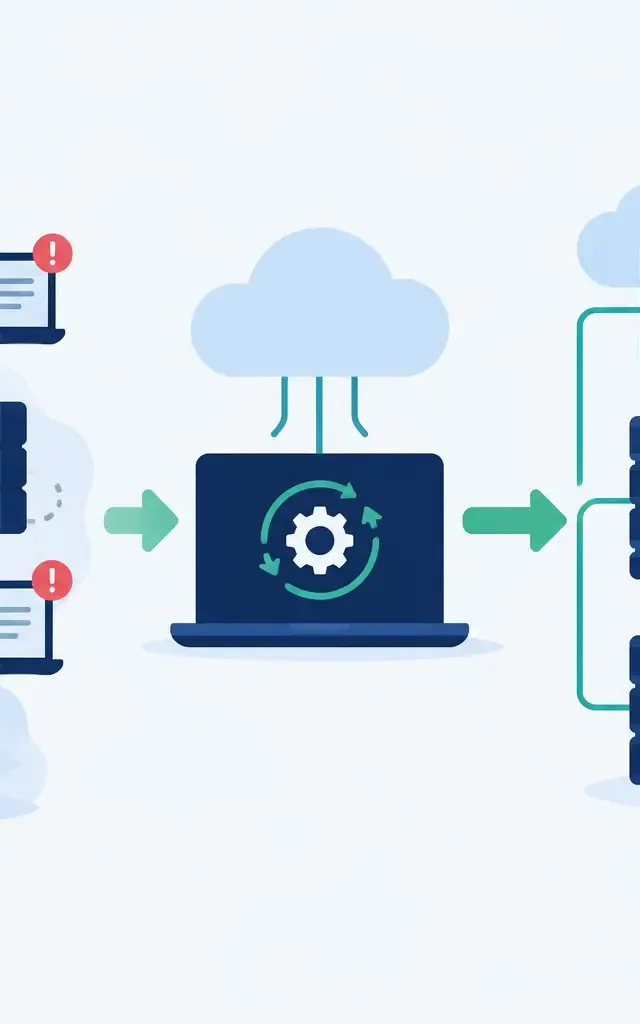
The traditional response is more scanning, more agents and more dashboards. That can create visibility, but it can also create noise and additional operational overhead. A better approach is to establish continuous intelligence from the systems already connected to the organisation, then relate configuration state to assets, identities, dependencies and business services.
This is where the trade-off becomes clear. A highly detailed benchmark applied everywhere may identify thousands of deviations, many with limited practical consequence. A risk-based programme still tracks the full baseline, but it prioritises the deviations that affect regulated data, externally exposed services, privileged access or operational resilience.
Secure configuration management guide: start with service context
A secure configuration programme has greater value when it is organised around the services the organisation must protect, rather than technology domains alone. A payroll service, patient system, manufacturing environment or citizen-facing portal has known owners, dependencies and acceptable levels of disruption. That context turns a technical finding into a decision.
Start by identifying the services that matter most to operations, regulation and revenue. Map the infrastructure, cloud resources, applications, identities and network paths that support them. The map does not need to be perfect on day one. It must be accurate enough to answer whether a configuration issue sits on a critical path.
For example, an unsupported cipher setting on an isolated test workload and the same setting on an internet-facing payment application should not receive the same response. Both may breach policy. Only one may require immediate action, executive visibility and a formal risk decision.
This service-led view also improves accountability. Security teams can define the control objective, while service owners can assess operational impact and approve remediation windows. IT teams receive a prioritised task that explains why it matters, rather than another unranked alert.
Define a baseline that can be measured
A baseline should express the secure state required for a particular environment, not a theoretical ideal that nobody can maintain. It should combine external standards with the organisation's risk appetite, architecture and contractual obligations.
For identity services, that may include strong authentication for privileged users, controlled administrator roles, inactive-account removal and documented break-glass access. For cloud platforms, it may cover public exposure, encryption, logging, key management and secure network configuration. For endpoints and servers, it may address patch levels, local administration, anti-malware settings, services and protocol hardening.
Avoid treating every exception as failure. Some systems need a legacy protocol, a specific privileged account or a non-standard configuration to operate safely. The control is not weakened by recognising this. It is weakened when the exception is undocumented, unowned and never reviewed.
Each baseline requirement should have a clear test, a named owner, an expected remediation route and an evidence source. If a team cannot state how a control is validated, how often it is assessed and who accepts an exception, it is a policy statement rather than an operational control.
Make exceptions time-bound
Permanent exceptions are often temporary decisions that were never revisited. Give every approved deviation a business owner, a reason, compensating controls, an expiry date and a review point. This prevents accepted risk from becoming invisible risk.
The expiry date matters because infrastructure changes. A legacy integration may be retired, a replacement platform may arrive, or a service may become more critical. A configuration that was reasonable six months ago may no longer be defensible.
Detect drift continuously, not only before an audit
Point-in-time audits can show whether a control was present on the day evidence was collected. They cannot reliably show what changed before or after that date. Continuous assessment closes that gap by detecting configuration drift as assets, services and identities evolve.
The priority is breadth with meaning. Visibility should cover on-premises infrastructure, cloud environments, SaaS services, directory services, endpoint management and network devices where relevant. It should also identify unmanaged or unknown assets, because a baseline cannot protect systems the organisation has not discovered.
Agentless and scanless collection can be particularly useful where operational sensitivity, estate scale or deployment friction makes traditional methods difficult. It reduces the need to place another component on every endpoint while supporting faster coverage across mixed environments. The right method depends on the estate: some specialist or isolated systems may still require dedicated tooling or carefully controlled assessment.
The output should not be a long list of failed settings. It should show the affected service, exposure route, associated identities, control owner, policy requirement and change history. This gives teams enough context to decide whether to fix immediately, schedule remediation, accept a temporary exception or investigate further.
Prioritise remediation by exposure and consequence
A useful prioritisation model combines technical severity with business consequence. Consider whether the asset is externally reachable, whether the configuration enables privilege escalation or data exposure, whether compensating controls exist, and whether the affected component supports a critical service.
A misconfigured administrator role linked to a high-value service may deserve attention before hundreds of low-risk workstation deviations. This is not an argument for ignoring hygiene. It is an argument for using finite engineering capacity where it reduces the most risk first.
Remediation must also be safe. Configuration changes can interrupt production, invalidate integrations or create unexpected access problems. Build change validation into the process. Test where possible, record the intended change, confirm the result after implementation and monitor the service for unintended effects.
Where immediate remediation is not possible, require a compensating control. That could include network segmentation, tighter monitoring, reduced privileges or restricted access. The point is not to make risk disappear on paper. It is to reduce exposure while a permanent fix is planned and owned.
Turn evidence into assurance
Audit readiness should be a by-product of daily control operation, not a project that begins weeks before an assessment. The evidence required by auditors, regulators and insurers is broadly consistent: what assets exist, what policy applies, the current control state, the exceptions approved, the remediation completed and the accountable owners.
When that evidence is assembled manually, it rapidly becomes stale. Screenshots are taken, spreadsheets are reconciled and teams spend valuable time proving work rather than improving security. Continuous evidence changes the model. It allows security, risk and compliance teams to show the current position, the trend over time and the actions taken when controls drifted.
For leadership, reporting should answer direct questions. Which critical services have the greatest configuration exposure? Is the risk reducing? Where are accepted exceptions concentrated? Which teams need investment or support? Board reporting does not need every technical setting. It needs defensible assurance that material risks are known, prioritised and being managed.
Build ownership into the operating rhythm
Secure configuration management works when security, IT operations, service owners and compliance teams use the same facts. Security defines the control outcome. IT owns the technical change. Service owners judge business impact. Compliance verifies that evidence and exceptions meet the required standard.
Set a regular rhythm for reviewing material drift, overdue exceptions and remediation progress. The frequency should reflect risk. High-consequence services may need daily visibility and weekly action reviews, while lower-risk estate areas may be assessed monthly. Consistency matters more than ceremony.
A consolidated platform such as Rebasoft can help teams connect asset intelligence, configuration state, vulnerabilities, identities and service context in one operational view. The benefit is not another dashboard. It is faster, better-supported decisions and evidence that leadership can trust.
The most effective programmes make secure configuration part of how services are run, changed and assured. When every deviation has context, ownership and evidence, teams spend less time debating alerts and more time reducing the risks that could genuinely affect the organisation.