A critical vulnerability on an isolated test server is not the same risk as a moderate weakness on a system supporting payroll, patient care, customer transactions or production operations. Yet many programmes still treat both as entries in the same remediation queue. This vulnerability management lifecycle guide explains how to turn technical findings into decisions that reduce cyber risk, protect essential services and give leadership answers they can trust.
The objective is not to close the highest possible number of tickets. It is to maintain a defensible view of exposure: what is connected, where it sits, which service it supports, who owns it and whether the required action has genuinely reduced risk. That requires a continuous operating lifecycle, not a periodic scan followed by a scramble for evidence.
What the vulnerability management lifecycle must achieve
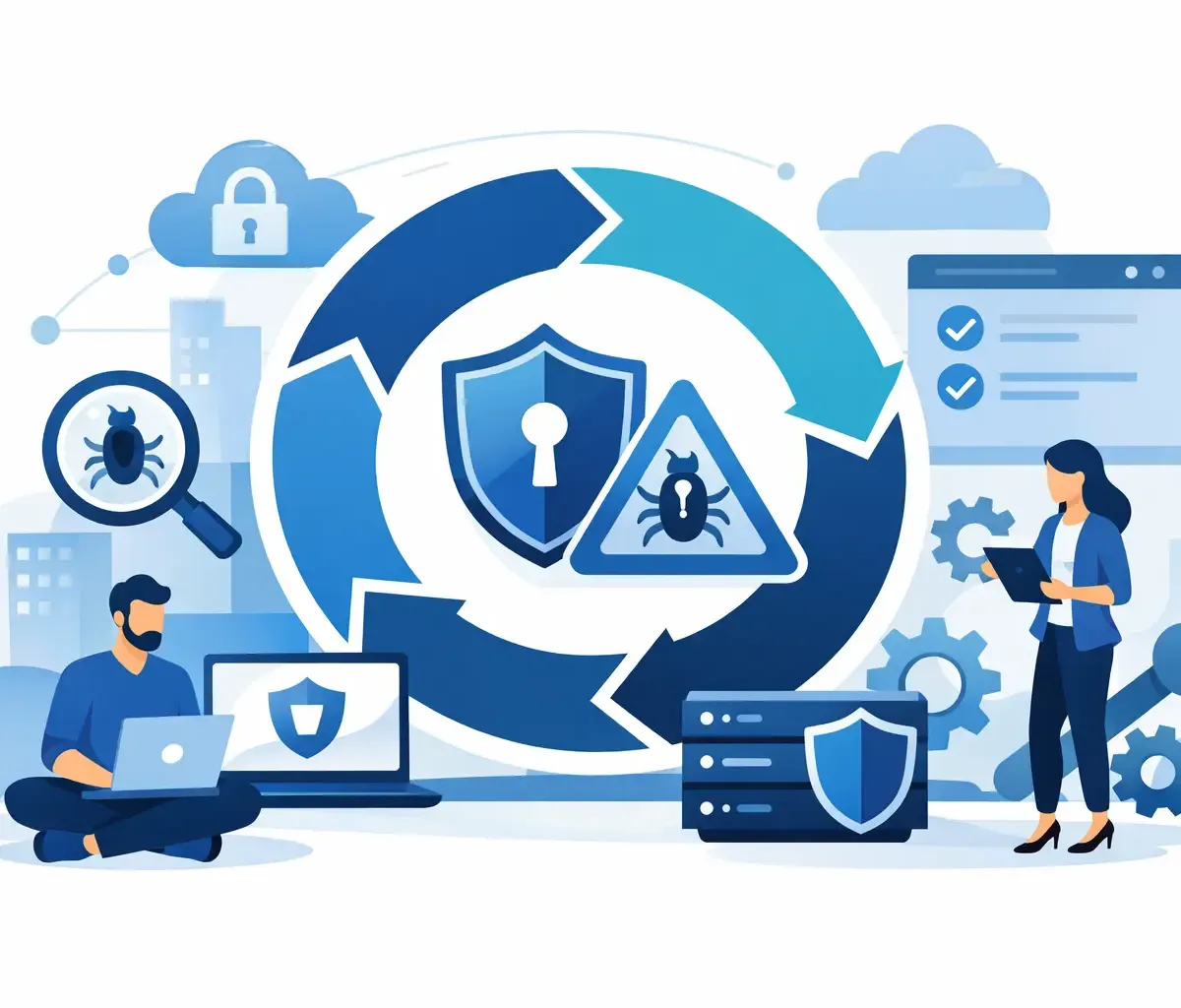
A mature lifecycle connects discovery, assessment, prioritisation, remediation, validation and reporting. Each stage depends on the quality of the one before it. If the asset inventory is incomplete, vulnerability data will be incomplete. If service ownership is unclear, remediation will stall. If validation relies on an assumption that a patch was applied, teams cannot prove that exposure has been removed.
This matters particularly in regulated and high-consequence environments, where audit teams and boards are not reassured by a large spreadsheet of CVEs. They need to know whether critical services are exposed, whether control failures are being managed within agreed timescales, and whether exceptions have an accountable owner.
The right lifecycle also recognises that patching is not always the answer. A vulnerable component may need a configuration change, compensating network control, software upgrade, service retirement or a formally accepted risk. The key is to make that decision deliberately, with evidence and a clear review date.
1. Establish a trusted asset and service baseline
You cannot manage vulnerabilities on assets you do not know exist. Start by building and maintaining a current view of on-premises infrastructure, cloud workloads, SaaS platforms, identities, network devices, operational technology and unmanaged endpoints. This is more difficult than it sounds because estates change constantly through cloud provisioning, mergers, remote working, third-party access and shadow IT.
The baseline must contain more than hostnames and IP addresses. It should show the asset type, operating system, software and configuration where available, network location, internet exposure, business owner, technical owner and the service or process it supports. A server without service context is an inventory record. A server mapped to a revenue-generating application or critical public service is a risk decision waiting to happen.
Agentless and scanless intelligence can reduce dependency on point-in-time assessments and help teams see change across complex estates without adding more endpoint overhead. It will not remove every need for specialist testing, particularly for bespoke applications, but it gives operations a stronger starting position than fragmented asset records and infrequent scans.
2. Identify vulnerabilities and control weaknesses continuously
Vulnerability identification should combine several sources: known software weaknesses, missing patches, insecure configurations, exposed services, unsupported operating systems, weak identity settings and deviations from approved standards. Treating CVE data as the entire programme leaves material exposure unaddressed.
Frequency should reflect risk. Internet-facing systems, privileged access infrastructure and services handling sensitive information warrant closer monitoring than low-impact internal devices. Equally, a monthly scan may be enough for a stable, segregated environment if changes are controlled and compensating controls are effective. The aim is proportionate assurance, not activity for its own sake.
Normalise findings into a common view. Without this step, teams waste time reconciling duplicate alerts from scanners, cloud tools, endpoint platforms and configuration products. A single issue may otherwise be assigned multiple times, while another is missed because it appears under an inconsistent asset name.
3. Prioritise by business exposure, not severity alone
Severity scores are useful, but they are not a remediation plan. A high technical score can be less urgent when the asset is isolated, unavailable to attackers and protected by strong controls. Conversely, a medium-rated issue on an internet-facing system supporting a critical service may require immediate action.
Effective prioritisation considers exploitability, active threat intelligence, external exposure, privilege level, asset criticality, data sensitivity, service dependency and the presence of compensating controls. It should also account for the scale of the affected population. A weakness affecting hundreds of similar endpoints can create a broader operational problem than a single, severe finding.
This is where business-service context changes the conversation. Security teams can explain not only that a vulnerability exists, but that it affects a named service, the number of exposed assets, the responsible team and the likely consequence of inaction. Leadership can then approve priorities based on risk appetite rather than a raw count of technical alerts.
4. Assign ownership and set realistic remediation paths
Every prioritised issue needs one accountable owner, a target date and an agreed treatment path. Shared responsibility often becomes no responsibility, especially where infrastructure, application, cloud and service teams each control part of the fix.
Set remediation timescales according to business impact and exposure. Critical internet-facing weaknesses with known exploitation may justify a same-day response. Other issues may be scheduled into a maintenance window, provided the rationale is documented and the risk remains acceptable. For legacy systems, a compensating control may be the only practical short-term option, but it must be specific: restrict access, segment the asset, remove unnecessary privileges, monitor closely and set a date to reassess.
A useful workflow distinguishes between remediation, mitigation, accepted risk and false positive. These are different outcomes and should not be hidden behind a generic status of “closed”. If a risk is accepted, capture who accepted it, why, which controls remain in place and when the decision expires.
5. Verify that the fix worked
A ticket marked complete is not proof of remediation. Changes can fail, be applied to the wrong asset, create a new configuration weakness or be reversed by automated deployment processes. Validation must confirm the vulnerable condition is no longer present and that the service remains functional.
The method depends on the issue. Patch status may be confirmed through system intelligence and version evidence. A configuration change may require comparison against a defined policy. An exposed port may need network validation. For critical services, operations should also check that the corrective action has not disrupted availability or performance.
Keep evidence attached to the lifecycle, not buried in individual inboxes or change records. Continuous evidence reduces audit effort because teams can show the original finding, decision, action, validation result and any exception in one traceable record.
6. Report risk in terms leaders can act on
Operational teams need detailed views of overdue actions, recurring weaknesses, ownership gaps and remediation performance. Executives need a different level of reporting: exposure across critical services, trend direction, risk accepted beyond policy, control coverage and the decisions requiring investment or intervention.
Avoid reporting vulnerability totals without context. A declining number can look positive while risk rises because the remaining findings sit on the most important services. Report the proportion of critical services with unresolved high-risk exposure, the age of those exposures, and whether the organisation can evidence control effectiveness.
This is also where platform consolidation can produce a commercial benefit. When asset intelligence, vulnerability management, configuration assurance and service context are kept in separate systems, reporting becomes a manual reconciliation exercise. A unified environment such as Rebasoft helps teams reduce duplication and provide evidence that is meaningful to both technical owners and the board.
7. Improve the lifecycle after every cycle
The lifecycle should reveal where the organisation is losing time or certainty. Perhaps newly provisioned cloud assets are not being assigned an owner. Perhaps a particular application repeatedly misses patch windows. Perhaps exceptions are approved without expiry dates. These are process weaknesses, not merely individual vulnerability findings.
Review performance regularly with service owners. Measure time to identify, time to triage, time to remediate, validation failure rates and the number of overdue exceptions. Then focus improvement effort on the constraint that most affects material risk. More scanning will not solve an ownership problem; more dashboards will not solve an incomplete asset baseline.
A vulnerability management lifecycle earns trust when it makes risk visible early, directs effort to the services that matter and leaves evidence behind. Build it around accountable decisions rather than alert volume, and every remediation action will carry more weight.