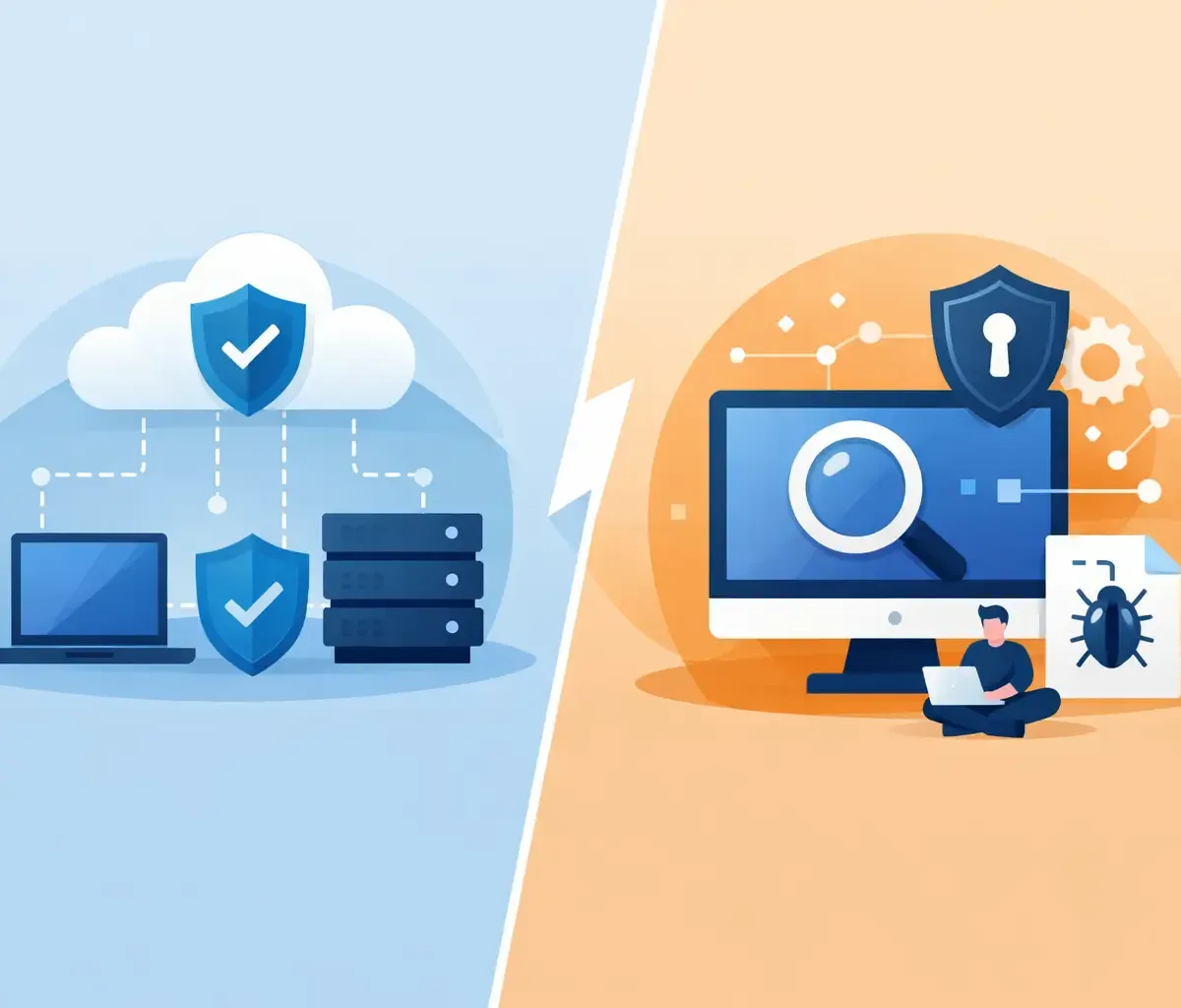
A critical vulnerability is only critical if it sits on an asset that matters, is exposed in a way that matters, and supports a service the organisation cannot afford to lose. That is the practical issue behind agentless vs agent based security. The question is not which method is universally better. It is whether your security team can see enough of the estate, validate controls continuously, and give leadership answers they can trust.
For most enterprises, public-sector bodies and managed service providers, the strongest outcome comes from using each approach where it provides credible evidence - rather than forcing every security requirement through one collection method.
What agent-based security does well
Agent-based security installs a lightweight piece of software on an endpoint, server, workload or device. The agent reports information back to a central platform and, in some cases, can take action locally. Endpoint detection and response, anti-malware, file integrity monitoring and detailed process telemetry commonly rely on this model.
Its principal advantage is depth. An agent can observe activity inside an operating system: processes starting, files changing, users logging on, registry changes, command execution and suspicious behaviour. It can continue collecting evidence when a laptop is away from the corporate network. For remote workforces and devices that spend long periods off-site, this persistence is valuable.
Agents can also support direct response. Security teams may isolate a compromised endpoint, stop a malicious process or collect forensic artefacts without waiting for a network scan. Where the requirement is threat detection and response on managed endpoints, agent-based tooling remains a necessary control.
That depth has an operational cost. Every agent requires deployment, version management, policy maintenance, exception handling and compatibility testing. Agents can consume system resources, conflict with other software or fail silently after an operating system update. Coverage is also conditional: if an asset is unknown, unmanaged, unsupported or deliberately excluded, it has no agent and may not appear in the security picture at all.
What agentless security does well
Agentless security collects intelligence without installing software on every asset. It may use existing infrastructure data, authenticated access, cloud APIs, network telemetry, directory services and configuration sources to identify assets, users, services, exposure and control status.
This approach is particularly effective for discovering what is already connected. It can identify unmanaged endpoints, network equipment, Internet of Things devices, operational technology, cloud resources and systems that would be difficult or inappropriate to equip with an agent. In a mixed estate containing on-premises Active Directory, Microsoft 365, Azure, AWS, Kubernetes and specialist operational systems, that breadth is often the difference between assumed visibility and actual visibility.
Agentless collection also reduces deployment friction. There is no endpoint rollout programme before the organisation gains value, no dependency on a user connecting to a corporate network, and no additional software footprint across thousands of devices. That can shorten time to value substantially, especially during an audit, acquisition, incident review or cyber insurance assessment.
The limitation is equally clear. Agentless methods do not generally provide the same continuous, process-level behavioural visibility as a dedicated endpoint agent. Their view depends on the quality, access and timeliness of the systems they interrogate. Credentials, API permissions and network segmentation must be governed carefully. Agentless does not mean effort-free, nor does it remove the need for well-designed security controls.
Agentless vs agent based security: the decision criteria
The choice becomes clearer when it is tied to the question being answered.
If the question is, “What is executing on this managed laptop right now, and can we contain it?”, an endpoint agent is usually the right tool. If the question is, “What is connected to our environment, who owns it, what service does it support, and which exposure creates the greatest business risk?”, an agentless approach is often better placed to provide the broad evidence required.
The following considerations matter more than product labels:
- Asset coverage: Agents work well on known, supported and managed devices. Agentless intelligence helps uncover unknown, unmanaged and diverse assets that cannot reliably run agents.
- Depth of telemetry: Agents provide detailed endpoint activity and response capability. Agentless methods provide wider infrastructure, identity, configuration and service context.
- Operational overhead: Agents introduce rollout, maintenance and performance considerations. Agentless methods reduce endpoint administration but still require sound access controls and source integration.
- Speed of assurance: Agentless collection can establish estate-wide visibility rapidly. Agent programmes may take longer to reach complete coverage, particularly across subsidiaries, legacy systems and third parties.
- Business context: Neither method alone automatically translates a finding into business impact. The security programme needs to connect assets, identities, dependencies and services before it can prioritise effectively.
A vulnerability scanner may identify hundreds of missing patches. An endpoint agent may confirm risky behaviour on a server. Neither result is sufficient on its own for a leadership decision. The decision improves when the organisation can establish that the server supports a revenue-critical service, is externally exposed, holds sensitive data, has a compensating control that has failed, and has a clear accountable owner.
Why a combined model is usually more defensible
Security architecture should reflect the estate you actually operate, not the estate shown in a procurement diagram. Most organisations have a mixture of modern managed endpoints, legacy servers, cloud workloads, transient devices, network appliances, third-party systems and OT assets. A single collection model will leave gaps.
Use agents where their endpoint-level visibility and response functions are essential. Use agentless intelligence to continuously identify assets and services, validate configuration and access posture, assess identity exposure, and detect coverage gaps in the agent estate itself. This creates a useful control loop: agentless discovery can reveal devices that lack required protection, while agent telemetry adds detail where investigation or containment is needed.
This combined model is also more credible during assurance activity. Auditors and regulators do not simply need a statement that a control exists. They need evidence that the control is operating, that its scope is understood, and that exceptions are identified and managed. A central evidence view reduces the manual task of collecting screenshots, spreadsheets and point-in-time exports from disconnected tools.
For MSPs and MSSPs, the same principle applies across customers. A scalable service needs a rapid way to establish visibility, identify material exposure and show measurable improvement, even where customers have different endpoint products or incomplete agent deployment. The service should not depend on waiting months for a perfect endpoint rollout before meaningful risk reduction begins.
Prioritise by service impact, not alert volume
The most damaging weakness in many security programmes is not a lack of alerts. It is a lack of prioritisation. Teams spend time closing technically severe findings while material business exposures remain unresolved because nobody has linked them to the services they support.
An effective assurance process should connect four things: the asset, the identity or configuration associated with it, the exposure or control failure, and the business service affected. This lets teams distinguish between a vulnerability in an isolated test environment and a weaker issue that exposes a critical public-facing service.
It also creates clearer accountability. Operations teams can see what must be fixed and why. Security teams can validate whether the control is working. Compliance teams can produce evidence without reconstructing it manually. Executives can see the direction of risk, the decisions required and the residual exposure accepted by the organisation.
Rebasoft is designed around this broader assurance requirement: continuous, agentless and scanless intelligence that connects technical findings to assets, services and business risk. It does not replace the need for endpoint protection where endpoint protection is appropriate. It helps organisations see the whole environment, validate what is in place and focus effort where it reduces cyber risk most.
Build the decision around evidence
Do not begin with “agents or agentless?” Begin with the evidence your organisation must be able to produce. Can you account for every connected asset? Can you identify systems without required endpoint controls? Can you demonstrate who has access to sensitive services? Can you show that secure configurations are being maintained? Can you explain, in business terms, what needs fixing first?
Where the answer is no, the gap is rarely solved by adding another dashboard. It is solved by bringing asset, identity, exposure, control and service intelligence into a view that supports action. Agent-based and agentless security are not opposing ideologies. Used deliberately, they give security leaders a more complete basis for reducing risk, improving resilience and giving leadership confidence in the evidence behind every decision.