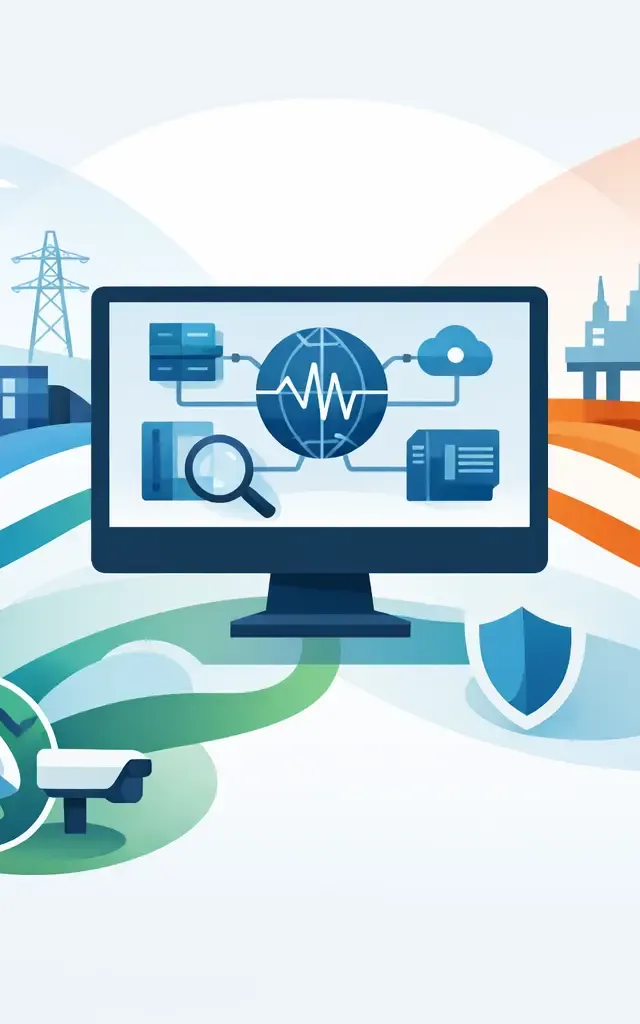
A critical vulnerability on an unmanaged device is not just an IT issue. It may interrupt a clinical system, expose customer data, delay a public service or invalidate an insurance assumption. Network visibility software should give teams the evidence to establish that connection quickly - before an incident, audit or board question forces a manual investigation.
For many organisations, the problem is not a lack of security data. It is too much disconnected data. Asset inventories, vulnerability scanners, cloud consoles, identity platforms, endpoint tools and service desks each hold part of the picture. None consistently explains what is connected, which business service depends on it, whether it is secure and who owns the decision to fix it.
The right visibility platform changes the question from “How many alerts do we have?” to “What could disrupt the organisation, and what should we address first?” That distinction is central to reducing cyber risk, improving operational resilience and giving leadership answers they can trust.
What network visibility software should reveal
Network visibility is often reduced to device discovery. Discovery matters, but it is only the starting point. A useful platform must identify assets across on-premises infrastructure, cloud environments, remote networks, operational technology and services that sit outside traditional endpoint management.
It should also establish relationships. A server name, IP address and criticality score are insufficient when a security team needs to know whether that server supports payroll, a production line, a citizen-facing portal or a dormant test environment. Context determines priority.
Effective visibility therefore brings together four connected views: what assets exist, how they communicate, which identities and services depend on them, and which exposures or control gaps create material risk. When those views are separate, teams spend their time reconciling records. When they are connected, they can make defensible decisions.
This matters especially in regulated and high-consequence environments. Auditors do not simply ask whether a policy exists. They ask for evidence that controls operate across the estate, that exceptions are understood and that remediation is tracked. Leadership needs the same confidence, expressed in terms of business impact rather than technical volume.
Why discovery alone does not reduce cyber risk
A one-off discovery exercise can produce an impressive inventory and still leave an organisation exposed. Networks change constantly. Cloud workloads are created and removed, users gain privileges, devices appear outside standard procurement, and application dependencies shift with every release.
A spreadsheet becomes inaccurate as soon as it is exported. Periodic scanning can identify weaknesses, but it may also create blind spots between scans and add operational overhead in sensitive environments. Agents provide useful endpoint detail, yet they cannot cover everything: unmanaged devices, network equipment, legacy platforms and third-party-connected assets often remain outside their reach.
This is where an agentless, scanless approach has clear value. By observing the environment continuously, teams can identify changes without relying solely on deployment projects, endpoint coverage or disruptive interrogation. It is not a replacement for every specialist control. Rather, it provides the shared intelligence layer that shows where controls are missing, inconsistent or failing to protect a business service.
The trade-off is that visibility must be designed around the organisation’s actual environment. A highly distributed enterprise may need extensive integrations and ownership data. An MSP may need strict customer separation, repeatable reporting and a consistent assurance service. A public-sector body may place particular weight on legacy technology and evidence for governance. The platform should accommodate those needs without turning into another disconnected console.
Network visibility software must add business context
Technical severity alone is a poor prioritisation method. A critical vulnerability on an isolated development asset may require less urgent action than a lower-severity weakness on a system supporting patient care, payments or essential public services.
Business context brings the right factors together: asset ownership, exposure, service dependency, identity privilege, control status, known vulnerabilities and the potential consequence of failure. It enables security, IT operations and service owners to work from the same facts.
Prioritise the work that changes risk
Teams rarely have the capacity to remediate every finding at once. Without context, the loudest alert or the newest vulnerability tends to dominate the queue. That approach creates activity, not necessarily risk reduction.
A better approach identifies the exposures that combine reachability, weakness and business consequence. For example, an unsupported device with privileged access to a core service deserves attention before a larger number of low-impact configuration findings. The decision can then be explained clearly to a service owner, an auditor or a board committee.
Turn control evidence into an operational asset
Compliance activity often becomes a scramble because evidence is scattered across tickets, spreadsheets, screenshots and individual teams. Continuous visibility allows organisations to collect evidence as part of normal operations. Instead of asking people to prove what was true six months ago, teams can show current control status, changes, exceptions and remediation progress.
This reduces audit effort, but the larger benefit is confidence. Evidence that is continuously available helps leaders test whether their assurance claims match reality. It also improves insurance readiness, where organisations increasingly need to demonstrate the controls they say they operate.
Reduce tool noise without losing specialist capability
Tool consolidation does not mean removing every existing security product. Endpoint detection, firewalls, identity controls and vulnerability tools all have specific jobs. The problem arises when each produces a separate version of the truth and requires separate reporting, ownership mapping and manual triage.
Network visibility software should sit above those silos, normalising intelligence and connecting it to services, assets and risk. This reduces duplicate effort and makes gaps visible. If an asset appears on the network but is absent from endpoint management, vulnerability assessment and the configuration baseline, that absence is itself a finding.
For operational teams, the gain is speed. They can investigate a change or incident with a clearer view of dependencies and ownership. For security leaders, the gain is prioritised risk reporting rather than a collection of product dashboards. For boards, the gain is a direct line between investment, control performance and resilience.
Rebasoft applies this model by bringing asset and service intelligence, vulnerability management, configuration assurance, identity visibility and compliance evidence into one environment. The aim is not more monitoring for its own sake. It is to help organisations establish what needs fixing first and demonstrate why.
How to assess a network visibility platform
Start with coverage, but do not stop there. Ask whether the platform can reveal assets and services across your actual estate, including cloud, on-premises, remote and unmanaged environments. A visibility claim that excludes the hardest-to-see areas will reinforce existing blind spots.
Next, assess context. Can the platform map technical assets to business services, owners and dependencies? Can it distinguish an internet-exposed production component from a low-impact internal system? If prioritisation still depends on analysts manually joining data from several tools, the platform has not solved the core problem.
Then examine evidence and workflow. A useful solution should show control status over time, identify exceptions and support clear remediation ownership. It should help compliance teams produce evidence without asking technical staff to recreate it for each audit cycle.
Finally, consider time to value. Large transformation programmes can delay the clarity they are meant to deliver. Look for an approach that can establish an accurate baseline quickly, expand through integrations where needed and produce meaningful operational and executive reporting early in deployment.
Make visibility part of resilience planning
Visibility delivers most value when it is used before a crisis. It supports routine hygiene by identifying unmanaged assets and weak configurations. It supports change management by showing potential service dependencies. It supports incident response by reducing the time required to understand scope, exposure and likely business impact.
It also creates a stronger conversation between technical and executive teams. Instead of reporting that hundreds of issues remain open, security leaders can explain which critical services are affected, which controls are operating as intended and where investment will reduce the greatest risk. That is the level of clarity required for accountable decision-making.
The most useful next step is not to collect another inventory. It is to establish a continuously evidenced view of the services your organisation cannot afford to lose, then use that view to direct every remediation decision that follows.