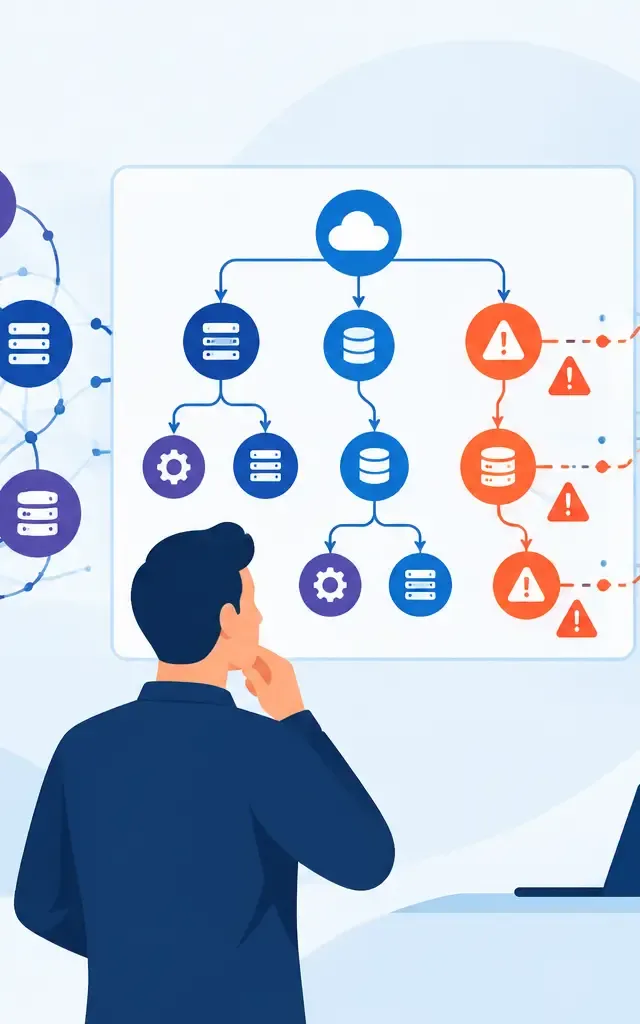
A control that passed its annual test may already be failing in production. A privileged account can be created after an access review, a firewall rule can be changed after a penetration test, and a critical service can be moved onto an unmanaged asset between audit checkpoints. Continuous control validation closes that gap by showing whether the controls the organisation relies on are operating now, not whether they worked when someone last collected evidence.
For security leaders, this is not a reporting refinement. It is a practical way to reduce cyber risk, shorten audit effort and give leadership answers they can trust. The difference is especially material in regulated, public-sector and high-consequence environments, where an unknown asset or failed control can affect a service that the organisation cannot afford to lose.
What continuous control validation means in practice
Continuous control validation is the ongoing testing of security, configuration and operational controls against current infrastructure, identities and services. It brings together live asset intelligence, policy expectations and service context to identify where a control is absent, misconfigured, overridden or no longer evidenced.
The word continuous needs sensible interpretation. It does not mean running every possible check every second. Different controls have different rates of change and different consequences. An internet-facing asset, a privileged identity or a cloud configuration supporting a critical service may warrant near-real-time visibility. A low-risk endpoint configuration may be checked on a scheduled basis. The objective is timely assurance that reflects risk, rather than a fixed calendar.
It also differs from basic monitoring. Monitoring can tell a team that a device is online, a log source has gone quiet or a configuration has changed. Validation asks a more useful question: does the current state satisfy the intended control, and what business service is exposed if it does not?
Why periodic assurance leaves too much uncertainty
Traditional assurance processes are often built around snapshots. Teams export reports, request screenshots, reconcile spreadsheets and ask system owners to confirm that controls are in place. This can satisfy an audit request, but it creates a large interval between evidence collection and the real-world condition it is meant to represent.
That interval is where risk accumulates. Hybrid estates change constantly: cloud workloads scale, Microsoft 365 permissions evolve, devices join and leave networks, and teams make urgent operational changes. The same organisation may have Active Directory, Intune, Kubernetes, Azure, AWS and on-premises infrastructure, each producing its own view of control status. Fragmented tools make it difficult to establish which view is authoritative.
The result is familiar. Security teams are overloaded with technical findings, compliance teams spend days chasing proof, and executives receive broad risk statements without a clear explanation of which services are affected or what should be fixed first.
Continuous validation changes the model from retrospective evidence gathering to ongoing evidence generation. It does not eliminate the need for auditors, control owners or professional judgement. It gives them a stronger factual basis for their work.
From control failure to business priority
A failed control is not automatically the most urgent issue. A missing security setting on an isolated test system is different from the same setting on a server supporting a clinical, financial or citizen-facing service. Treating both as equal creates noise and slows remediation.
Useful validation therefore depends on context. Teams need to understand what is connected, who owns it, what identities can access it, which service depends on it, whether it is exposed, and what compensating controls exist. Only then can they decide whether a finding represents a routine configuration task, an urgent security incident or an acceptable exception.
Consider an inactive endpoint protection control. On its own, it is a technical finding. If the affected machine is a domain controller, a jump host or part of a revenue-critical service, the priority changes immediately. Equally, a configuration deviation may be less urgent where network segmentation, restricted access and short asset life provide credible mitigation. Continuous validation should reveal these distinctions, not flatten them into a single compliance score.
This is where asset and service intelligence become essential. A control cannot be reliably validated against assets the organisation does not know about. Nor can leadership make sound decisions when control results have no connection to operational impact.
The evidence model security teams actually need
Effective continuous control validation creates a chain of evidence from policy to action. It begins with a clear definition of the expected state: for example, privileged accounts require multi-factor authentication, externally exposed services require approved configurations, or critical servers must have a defined security baseline.
The platform must then observe the relevant environment and compare current conditions to that expectation. When a deviation appears, the result needs enough detail to be useful: the affected asset or identity, the failed requirement, the service and owner involved, the date and time, and the remediation or exception status.
This evidence should persist. Auditors and compliance teams need to see not only the present state but also whether a control failed, how long it remained out of tolerance, who accepted the risk and when it was corrected. A dashboard that changes colour without historical evidence may be helpful operationally, but it is weak assurance.
The strongest model also distinguishes between a failed control and an unvalidated control. If the organisation has no current visibility of an asset, a disconnected data source or a newly discovered service, it should not be treated as compliant by default. Unknown should be visible as a risk condition in its own right.
Where organisations should start
Trying to validate every control across every environment at once usually produces delay and debate. A better starting point is a focused set of controls tied to material business risk. Begin with the assets, identities and services that would cause the greatest operational, regulatory or financial impact if compromised or unavailable.
Prioritise controls that change frequently, are difficult to evidence manually or repeatedly appear in audit findings. In many organisations, this includes privileged access, exposed services, asset inventory completeness, security configuration baselines, vulnerability remediation status and coverage of protective tooling. The correct starting set depends on the estate and regulatory obligations, but the principle is consistent: validate the controls that most affect resilience.
Control owners should agree what good looks like before automation begins. Ambiguous policy language creates ambiguous results. A statement such as “systems should be patched promptly” cannot be assessed consistently without defined thresholds, scope and exceptions. A control that cannot be described clearly cannot be validated reliably.
Once the first controls are live, establish a practical operating rhythm. Security teams need a route for urgent remediation. Service owners need clear accountability for routine fixes. Risk and compliance teams need a defensible exception process with review dates. Leadership needs concise reporting that shows whether assurance is improving, where risk remains concentrated and whether investment is reducing exposure.
Agentless visibility changes the economics of assurance
Traditional validation often relies on deploying agents, scheduling scans and joining data from several point products. Those approaches can be appropriate in some environments, particularly where deep endpoint telemetry is required. They also introduce coverage gaps, operational overhead and friction with systems that cannot accept additional software.
An agentless, scanless approach can reduce that burden by using existing infrastructure and service data to build ongoing visibility. It is particularly valuable where organisations need to understand diverse estates quickly, including cloud platforms, identity systems, networked devices and legacy infrastructure. The benefit is not simply faster deployment. It is a more complete view of the assets and services against which controls must be validated.
Rebasoft applies this principle by bringing discovery, service context, control validation and evidence into one environment. For teams managing overlapping cyber, IT operations and compliance tools, consolidation can reduce both cost and the time spent reconciling contradictory findings.
There are limits to consider. Agentless intelligence does not remove the need for specialist tools in every case, and a platform should integrate with the controls and telemetry already delivering value. The goal is not tool replacement for its own sake. It is to remove blind spots and duplication while improving the quality of assurance.
Reporting that supports decisions, not just audits
Board reporting should not be a technical inventory of failed checks. Executives need to know whether critical services are operating within agreed risk tolerance, whether unresolved control failures are increasing or falling, and where decisions or investment are required.
That demands a different reporting structure. Show trends over time, the concentration of unresolved issues around key services, the age of exceptions and the evidence behind compliance claims. Pair technical measures with operational consequences: exposed critical assets, privileged identities outside policy, or services dependent on unsupported infrastructure.
For MSPs and MSSPs, the same approach creates a stronger managed service. Customers can see current assurance, agreed remediation priorities and defensible evidence across their estate, rather than receiving a periodic report that is out of date as soon as it is issued.
The most useful next step is not to create another compliance dashboard. Choose one critical service, identify the controls that protect it and establish whether you can prove their current state. The gaps that emerge will show exactly where assurance needs to become continuous.