When a critical service fails, leadership does not need a count of open vulnerabilities. It needs clear answers: what has stopped, who is affected, whether the cause is contained, and how quickly the service can return safely. That is the practical standard for how to assess cyber resilience.
Cyber resilience is not simply the ability to prevent an attack. It is the organisation’s ability to anticipate disruption, withstand it, detect it quickly, respond with control, and recover the business services that matter most. A useful assessment connects technical conditions to those outcomes. If it cannot show how an exposed asset, compromised identity or failed control affects a business service, it will create noise rather than assurance.
Start with the services the organisation cannot afford to lose
A resilience assessment should begin with business dependency, not the security toolset. Identify the services whose disruption would create material operational, financial, regulatory or safety consequences. For a local authority, that may include citizen services and payments. For a manufacturer, it may be production scheduling, operational technology access and the supply chain. For a financial services firm, it could be customer transactions, market access and identity services.
For each service, establish an accountable owner, the users and customers it supports, the systems and data it relies on, third parties involved, and the acceptable level and duration of disruption. Recovery time and recovery point objectives are useful, but they should not be treated as a paper exercise. Ask whether the supporting architecture, backups, access arrangements and response procedures can actually meet them.
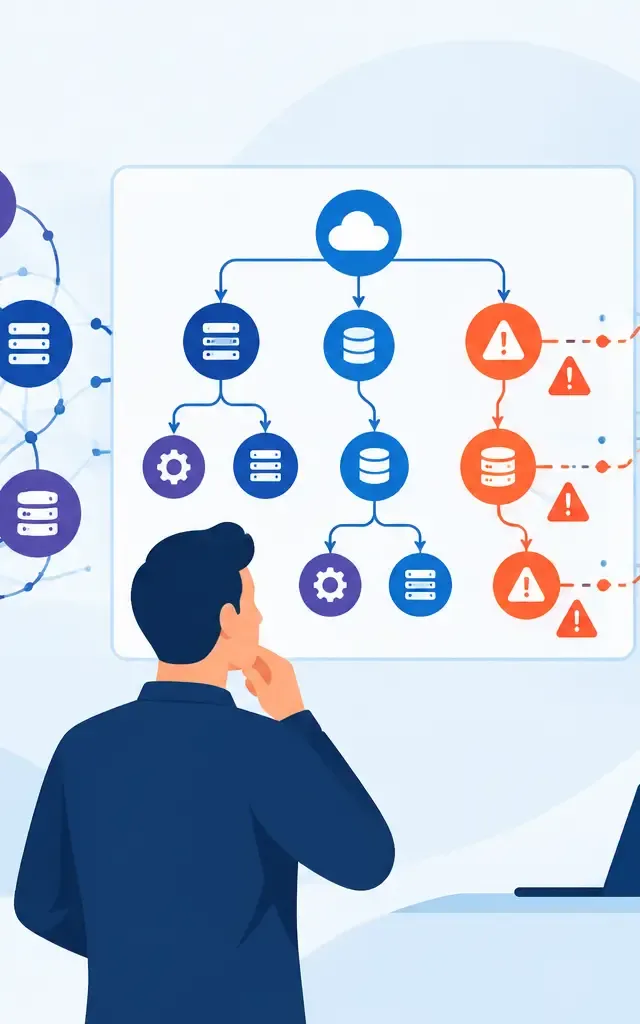
This work exposes a common weakness: organisations often know their individual applications but not the chain of dependencies that delivers a service. A cloud-hosted application may depend on on-premises Active Directory, Microsoft 365, a privileged support account, a network device, an integration platform and an external supplier. Resilience fails at the weakest dependency, not at the service diagram’s headline application.
How to assess cyber resilience through five evidence areas
A credible assessment brings together evidence from the environment rather than relying on policy statements or annual questionnaires. The following five areas provide a practical structure.
1. Asset and service visibility
You cannot assess the resilience of assets you do not know exist. Establish a current inventory across cloud, on-premises infrastructure, endpoints, network devices, identities, applications and operational technology where relevant. The inventory must show more than hostname and IP address. It should identify ownership, criticality, location, operating system, configuration state and service relationship.
Pay particular attention to unmanaged devices, dormant systems, internet-facing assets, legacy platforms and privileged identities. These are often where a minor technical gap becomes a service-level incident. Agentless, scanless intelligence can help teams build this view without adding further deployment overhead or creating blind spots where agents are absent.
The key test is straightforward: can a team identify all assets supporting a critical service within minutes, and can it distinguish them from systems that have little business impact? If not, response decisions will be slower than they need to be.
2. Exposure and control effectiveness
Vulnerability counts alone do not measure resilience. A critical vulnerability on an isolated test server does not carry the same risk as a lower-severity issue on an internet-facing identity platform supporting customer access. Prioritisation must consider exploitability, exposure, compensating controls, asset criticality and the service affected.
Assess whether essential controls are present and working: secure configuration, patch status, multi-factor authentication, privileged access restrictions, network segmentation, logging, backup protection and endpoint coverage. The question is not whether a control exists in a standard. It is whether it is consistently applied to the assets and identities that support important services.
There are trade-offs. Immediate patching may not be appropriate for fragile operational systems or applications with demanding change controls. In those cases, the assessment should document the alternative safeguards, the owner, the review date and the residual business risk. A justified exception with evidence is stronger than a nominally compliant control that is not operationally realistic.
3. Detection and response readiness
Resilient organisations reduce the time between compromise and confident action. Assess how quickly the security and IT teams can recognise suspicious activity, establish scope and make decisions without waiting for several teams to reconcile conflicting data.
Test realistic scenarios, such as a compromised privileged account, ransomware affecting a file service, a failed cloud identity control or an unauthorised network device. Can the team answer which accounts were used, which systems were reached, which services are at risk and which controls can contain the incident? Can it preserve evidence while restoring operations?
Measure more than alert volume. Useful indicators include time to identify affected services, time to validate containment, percentage of critical systems with usable telemetry, and the proportion of incident actions supported by current evidence. These measures show whether detection is helping operations or merely generating tickets.
4. Recovery capability
Recovery is where many resilience claims are tested. Backups are necessary, but the existence of a backup job does not prove that a service can be restored. Assess backup scope, immutability, segregation of administration, retention, restoration speed and the dependency order required to bring the service back.
Run recovery tests that reflect the business service, not only a single server or database. A successful technical restore may still leave users unable to work because identity, DNS, certificates, integrations or network rules have not been recovered. Include manual workarounds, communications, supplier escalation and decision authority in the exercise.
The appropriate testing frequency depends on the service’s impact and rate of change. A critical customer-facing platform needs more frequent validation than a low-use internal reporting tool. What matters is that leaders can see the most recent evidence, the failed test steps and the actions taken to close gaps.
5. Governance, assurance and learning
A resilience assessment should give leadership answers they can trust, without forcing them to interpret technical dashboards. Report against critical services, not just control domains. Show the current risk position, the evidence behind it, accountable owners, overdue remediation and the likely consequence of inaction.
This also reduces audit effort. Instead of collecting screenshots and spreadsheets shortly before an audit, retain continuous evidence of assets, controls, exceptions, tests and corrective actions. Auditors and insurers will still ask questions, but the organisation can answer with a traceable record rather than a last-minute reconstruction.
After incidents and exercises, assess whether lessons resulted in measurable change. A post-incident review that identifies weak privileged access but does not verify that access has been tightened is not resilience improvement. Close the loop by assigning actions, validating completion and reassessing the affected service.
Turn findings into a prioritised resilience plan
The final output should not be a long register of technical defects. It should be a ranked plan that shows what needs fixing first, why it matters and how progress will be verified. Group actions by the business service at risk, then separate immediate containment from longer-term improvement.
For example, an exposed remote access service supporting finance may require immediate access restrictions, multi-factor authentication enforcement and monitoring improvements. The longer-term work may include redesigning identity dependencies, improving supplier access governance and rehearsing recovery. Both horizons matter, but they should not compete for attention as if they carry equal urgency.
Set a small number of measures that leadership can review consistently: critical-service coverage, unresolved high-impact exposures, control validation rates, recovery test success, time to establish incident scope and overdue resilience actions. Avoid changing measures every quarter. Trends are what reveal whether resilience is improving.
For MSPs and MSSPs, the same discipline creates a scalable service model. Standardised evidence collection and service-based reporting allow partners to show customers where risk is concentrated, prove the value of remediation work and deliver assurance without increasing manual effort for every tenant.
Make resilience assessment continuous
An annual assessment can establish a baseline, but infrastructure, identities, suppliers and threats change too quickly for annual evidence to remain reliable. Treat cyber resilience as a continuous assurance process: discover change, validate controls, identify service impact, prioritise action and report progress.
Rebasoft supports this approach by bringing asset, identity, vulnerability, configuration and service intelligence into one operational view. The objective is not another dashboard. It is faster, evidence-based decisions about the services the organisation needs to keep running.
The strongest resilience assessment is one that changes the next operational decision. When an incident occurs, the team should already know what matters, what is exposed, who owns the response and what recovery will require. That is how cyber assurance becomes business confidence.