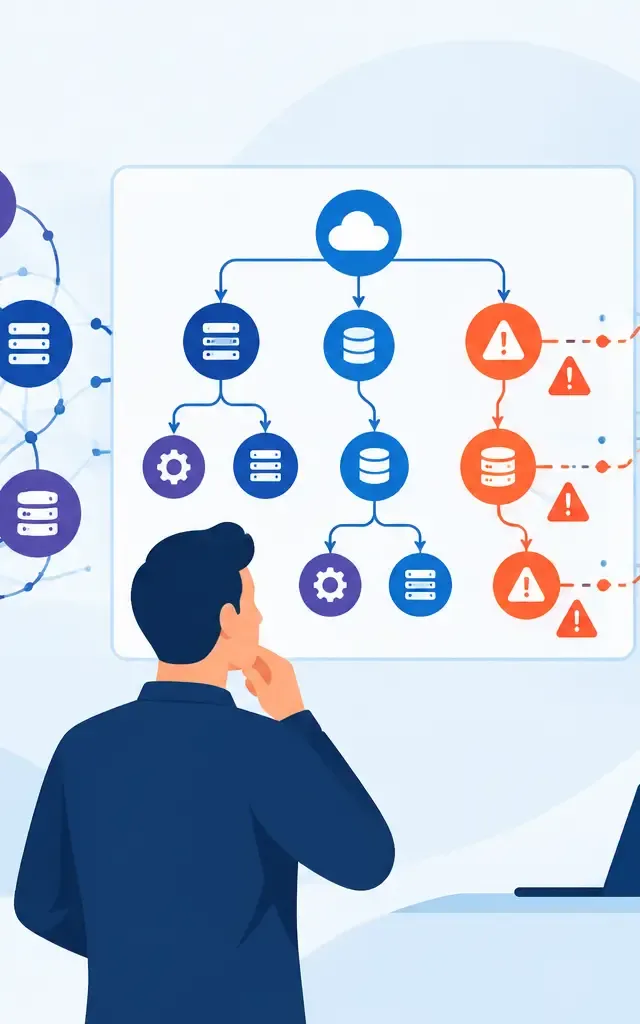
A CISO should not need three dashboards, a spreadsheet and a week of meetings to answer a straightforward question: which business services are exposed, and what should we fix first? Yet that is the reality in many organisations. Security tool consolidation addresses the problem at its source by replacing disconnected data, duplicated controls and conflicting priorities with a trusted operational view.
The objective is not to own fewer products for the sake of a cleaner procurement register. It is to reduce cyber risk, improve resilience and give leadership answers they can trust. Done well, consolidation helps security, IT and compliance teams work from the same evidence, with the same understanding of business impact.
Why security estates become difficult to manage
Most security estates did not become fragmented through poor decision-making. They grew in response to genuine needs. A new endpoint tool addressed ransomware concerns. A cloud security platform supported a migration programme. A vulnerability scanner met an audit requirement. An identity product improved access governance.
Over time, however, each tool creates its own inventory, scoring model, alert queue and reporting process. The result is often more data but less certainty. Asset records disagree. A critical vulnerability is treated as urgent even though the affected system supports no live service. Meanwhile, an overlooked configuration issue on a public-facing platform may create a far more immediate exposure.
This fragmentation also creates operational cost. Teams spend time reconciling asset lists, exporting evidence for auditors and deciding which finding is authoritative. MSPs and MSSPs face the same challenge across multiple customer environments, where separate consoles make consistent service delivery harder to achieve.
Security tool consolidation is a control decision
Security tool consolidation should be treated as a control and assurance decision, not simply a cost-cutting exercise. The right platform provides continuous visibility of assets, identities, services, configurations and exposures, then connects them to the business services that matter.
That context changes prioritisation. A high-severity technical finding is not automatically the first job. Its priority depends on whether the affected asset is reachable, whether it is actively used, which identities can access it, what service it supports and what compensating controls are already in place. Conversely, a seemingly modest issue may demand immediate action if it affects a critical operational service or creates a gap in a regulated control.
A consolidated approach must therefore do more than collect alerts in one place. It needs to establish what is connected, what is exposed, what is working and what needs fixing first. If it cannot provide that chain of evidence, it may be a portal for multiple tools rather than a meaningful reduction in complexity.
What to consolidate, and what to retain
Consolidation does not mean removing every specialist product. Some environments have legitimate requirements for dedicated technology, particularly in operational technology, specialist threat detection, highly regulated workloads or complex cloud engineering. The question is whether each product provides distinct evidence or control capability that cannot be delivered more effectively through the core platform.
Start by examining the areas where overlap causes the most friction. These commonly include asset discovery, vulnerability exposure, secure configuration assessment, identity visibility, compliance evidence and executive reporting. When each function is managed separately, teams lose the relationships between them.
A practical assessment should test four questions:
- Does the tool reveal information unavailable from another source?
- Does it support a control that would otherwise be weakened?
- Can its evidence be correlated with assets, users and business services?
- Does its operational effort justify its risk reduction?
The answer will vary by organisation. A public-sector body managing legacy infrastructure may retain specialist monitoring while consolidating assurance and reporting. A fast-growing enterprise may prioritise cloud, Microsoft 365 and identity visibility first. The best programme follows material risk and operational need, not a blanket rule about product numbers.
Build consolidation around evidence, not dashboards
A consolidation programme fails when it begins with a visualisation project. A single dashboard can look convincing while still relying on incomplete inventories, stale scans and unverified assumptions. Leadership does not need more colourful charts. It needs defensible evidence that controls are operating and risk is being managed.
Begin with a reliable picture of the environment. That includes on-premises infrastructure, cloud platforms, endpoints, network-connected devices, Active Directory, Microsoft 365, Intune, Kubernetes and third-party-connected services where relevant. Agentless and scanless intelligence can be particularly valuable where deploying agents is slow, disruptive or impractical, and where continuous visibility is more useful than periodic snapshots.
Next, map technical assets to services and owners. This is the step that turns findings into decisions. When a server, identity or configuration is linked to a business service, teams can see the consequence of failure and assign responsibility with less debate. It also makes board reporting more credible because technical risk can be expressed in operational terms.
Finally, measure control effectiveness continuously. Audit readiness should not rely on a manual evidence-gathering exercise before an assessment. A stronger model keeps evidence current, shows exceptions clearly and demonstrates remediation progress over time.
The operational gains that matter
The commercial case for security tool consolidation is often framed around licence rationalisation. That matters, but it is rarely the largest benefit. The greater value comes from reducing the time between identifying a problem and making a sound decision.
Security teams gain a cleaner, prioritised workload rather than several competing queues. IT teams receive findings with service context, which reduces the familiar dispute over whether an issue is real, urgent or owned by their team. Compliance managers can retrieve evidence from the operational environment instead of chasing screenshots and spreadsheets. Executives see risk against critical services, control status and remediation progress rather than a raw count of alerts.
This also improves insurance readiness. Insurers increasingly ask organisations to demonstrate asset visibility, vulnerability management, identity controls and evidence of governance. A consolidated evidence base makes those conversations more precise. It does not guarantee favourable terms, but it gives the organisation a stronger basis for showing that cyber risk is actively managed.
For managed service providers, the gain is consistency. A shared platform can support repeatable assurance services across customers, while retaining each customer's assets, risk posture and reporting requirements. That enables a managed service to be built around outcomes, not just the administration of disconnected products.
Avoid the common consolidation mistakes
The first mistake is replacing several tools with one platform before establishing data quality. If unknown assets remain unknown, consolidation merely centralises the blind spot. Discovery and validation must come before rationalisation.
The second is measuring success only by the number of products retired. Removing a product may reduce spend, but it can also create a control gap if its function has not been proven elsewhere. Measure coverage, evidence quality, remediation time and reduction in duplicated effort alongside licence savings.
The third is treating integration as an end point. Integrations are useful, but a collection of feeds does not automatically produce assurance. The platform must normalise the data, preserve ownership, identify relationships and prioritise action according to real business exposure.
Rebasoft approaches this problem by bringing asset and service intelligence, vulnerability management, secure configuration, identity visibility and compliance assurance into one operational environment. The aim is clear: help teams establish the facts quickly, focus effort where it will reduce risk, and provide evidence that stands up to executive and audit scrutiny.
A sensible path to consolidation
Start with one high-friction use case, such as unknown assets supporting critical services, duplicated vulnerability reporting or the manual production of compliance evidence. Establish a baseline for asset coverage, open exposure, time spent on reporting and remediation ownership. Then prove that a consolidated view improves decisions in that area before expanding the scope.
This staged approach reduces disruption and creates internal confidence. It also exposes where specialist controls still add value. Over time, the organisation can retire overlapping tools with evidence rather than optimism, while building a more coherent view of cyber and operational resilience.
The strongest outcome is not a smaller technology estate on its own. It is an organisation that can answer difficult questions quickly, show why its priorities are justified and act before a technical weakness becomes a business interruption.