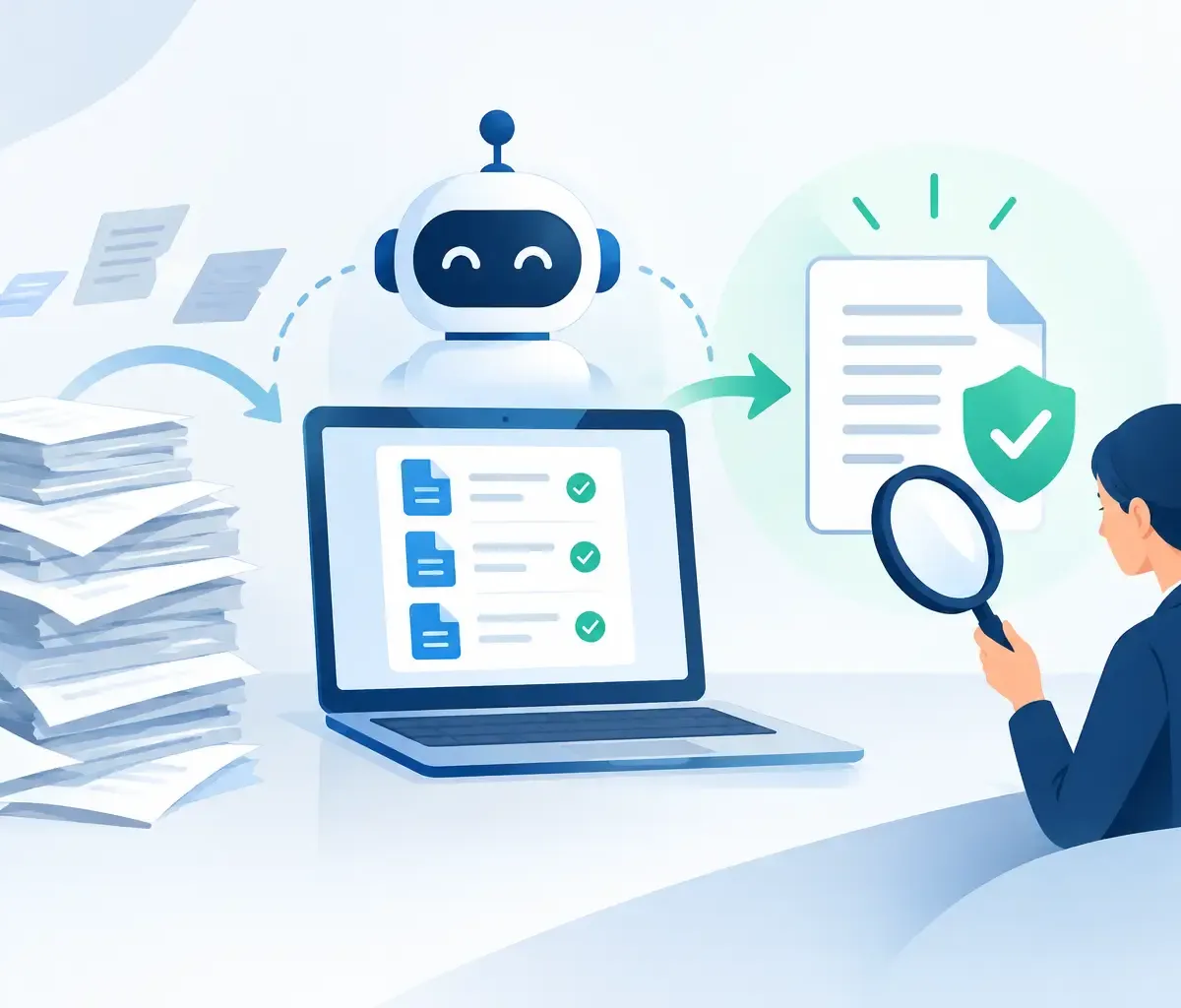
An auditor asks for proof that privileged access was reviewed, critical systems were patched, and unauthorised devices were identified. The usual response is a familiar scramble across spreadsheets, ticketing systems, cloud consoles and inboxes. Audit evidence automation changes that pattern by making evidence a continuous operational output rather than a project assembled shortly before an audit.
For regulated organisations, the value is not simply faster document collection. It is the ability to show what was known, what action was taken, who was accountable and whether the control operated as intended. That gives leadership answers they can trust, reduces disruption for operational teams and creates a stronger basis for risk, resilience and insurance discussions.
Why manual evidence gathering creates avoidable risk
Most organisations do not lack security tools. They lack a dependable way to connect the information those tools produce to controls, business services and audit requirements. An asset inventory may sit in one platform, vulnerability data in another, identity records in Microsoft 365 or Active Directory, and change evidence in a service desk. Each source may be useful, but assembling a coherent control narrative remains manual.
That creates three problems. First, evidence is often a point-in-time snapshot. A report exported in March cannot prove what happened in February, nor explain whether an exception was resolved. Secondly, teams spend valuable time reconciling conflicting data rather than reducing risk. Finally, the resulting evidence can be difficult for an auditor or executive to interpret because it describes technical activity without showing the affected service or business consequence.
The pressure intensifies when the scope includes hybrid estates. A critical service may rely on Azure resources, on-premises Active Directory, managed endpoints, Kubernetes workloads and third-party connections. If visibility is incomplete, assurance is incomplete. A clean report from one system does not compensate for unknown assets or unmonitored identities elsewhere.
What audit evidence automation should actually do
Automation is not the automatic production of attractive PDFs. It is a controlled process for collecting, validating, retaining and presenting evidence from authoritative sources. The evidence must remain traceable to the control being tested and meaningful at the time it was captured.
A useful approach starts with continuous discovery. The organisation needs a current view of connected assets, services, identities, configurations and exposures. Without that baseline, it is impossible to prove that a control applies to the complete population. For example, an endpoint patching report has limited value if unmanaged devices are absent from the endpoint management platform.
Next, the platform should correlate technical observations with the controls that matter. A failed configuration check should not appear merely as a low-level finding. It should show the relevant control objective, the system or service affected, the owner, the duration of the exposure and the remediation status. That turns evidence into assurance rather than a collection of disconnected alerts.
Finally, the platform should preserve the audit trail. Auditors may reasonably ask when an issue was identified, what evidence supported the finding, whether it was accepted as a risk, and how the exception was closed. Automated evidence needs timestamps, source context and a clear record of change. If a control changes, the rationale and approval should be visible too.
Continuous evidence is stronger than periodic proof
Periodic testing still has a place. Some controls require human judgement, interviews or formal sign-off that no platform can replace. But many recurring checks can be measured continuously: asset presence, software versions, encryption status, privileged group membership, exposed services, configuration drift and vulnerability remediation.
Continuous evidence gives compliance teams an earlier warning when a control begins to fail. Instead of discovering at year end that an access review was missed or a critical configuration drifted months earlier, the responsible team can act while the issue is contained. That reduces cyber risk and shortens the gap between finding a problem and fixing it.
It also changes the quality of the audit conversation. Rather than presenting a static assertion that a control was effective on one day, the organisation can show a history of performance, exceptions and remediation. This is particularly valuable in high-consequence environments, where an auditor will want to understand not only policy design but operational reality.
Build audit evidence automation around business services
Technical evidence alone can overwhelm decision-makers. A list of 400 vulnerabilities does not tell a board whether customer services, payroll, clinical systems or operational technology are at risk. Prioritisation requires business context.
Map assets, identities and configurations to the services they support. Then the organisation can distinguish between a missing patch on a test server and an exposure affecting a revenue-generating application or essential public service. The first may be routine work; the second may require escalation, compensating controls and executive oversight.
This service-led view also improves audit scoping. Instead of asking every technical team for every possible artefact, auditors and control owners can focus on the systems that support material processes. Evidence becomes more relevant, while teams avoid spending weeks producing data that does not change the assurance outcome.
Rebasoft applies this principle by connecting asset and service intelligence, vulnerability and configuration visibility, identity insight and compliance evidence in one environment. The objective is straightforward: show what is connected, what is exposed, which business service is affected and what needs fixing first.
Where automation needs human control
Not every control should be fully automated, and treating automation as a substitute for governance creates its own risk. A platform can identify that a privileged account exists. It cannot always decide whether the access remains justified for a particular role or emergency situation. Similarly, it can report configuration drift, but a technical owner may need to confirm whether an approved change explains it.
The right model is automated collection with accountable review. Define who owns each control, how exceptions are approved, how long they may remain open and what evidence is required to close them. This protects against a common failure mode: a large volume of automated findings with no agreed decision or remediation path.
Source quality matters too. Evidence is only as reliable as the systems and data feeding it. Organisations should identify authoritative sources, test integrations and document known limitations. If a cloud account, network segment or subsidiary is outside coverage, state that clearly. Honest scope is more defensible than assumed completeness.
A practical route to better audit readiness
Start with the audit requests that consume the most time or expose the greatest uncertainty. For many organisations, these are asset completeness, vulnerability management, privileged access, secure configuration and evidence that critical services are being monitored.
For each area, define the control objective in plain language. Then establish the population being tested, the source of truth, the acceptable threshold, the evidence retained, the owner and the escalation route for failure. This discipline prevents automation from becoming another reporting layer without operational purpose.
Avoid trying to automate every framework requirement at once. A phased programme usually produces better results. Begin with controls where evidence is already available but fragmented, then expand into areas where discovery, service mapping or data quality need improvement. Early results build confidence and expose practical gaps before they become audit findings.
For MSPs and MSSPs, the same model must work across customers without requiring a separate manual process for each one. Standardised evidence packs, tenant-level reporting and clear service-based prioritisation help managed service teams provide assurance at scale without increasing staffing in line with customer numbers.
The outcome is confidence, not more reporting
The test of audit evidence automation is simple. Can a control owner explain its current status in minutes? Can an auditor trace the evidence back to its source? Can leadership see which open issues threaten important business functions and whether action is under way?
When the answer is yes, audit readiness stops being a seasonal exercise. It becomes part of daily operational control. Start with the evidence your teams repeatedly chase, connect it to the business services that matter most, and make every exception visible enough to be owned.