A critical asset is not simply the server with the highest vulnerability score or the system owned by the most vocal department. It is the asset whose failure, compromise or unavailability would materially disrupt a business service. Knowing how to classify critical assets therefore starts with a business question: what must continue to operate, even under pressure?
For regulated organisations, public-sector bodies and complex enterprises, getting this wrong has consequences beyond a delayed IT project. It can affect patient care, public services, revenue collection, contractual commitments, safety, regulatory reporting and cyber insurance readiness. Yet many asset registers still classify importance using subjective labels, incomplete ownership data or a basic production versus non-production split.
That approach creates noise. It leaves security teams patching what is visible rather than protecting what matters most. A useful classification model connects every asset to the service it supports, the people who depend on it, and the consequences of its loss.
Start with the business service, not the device
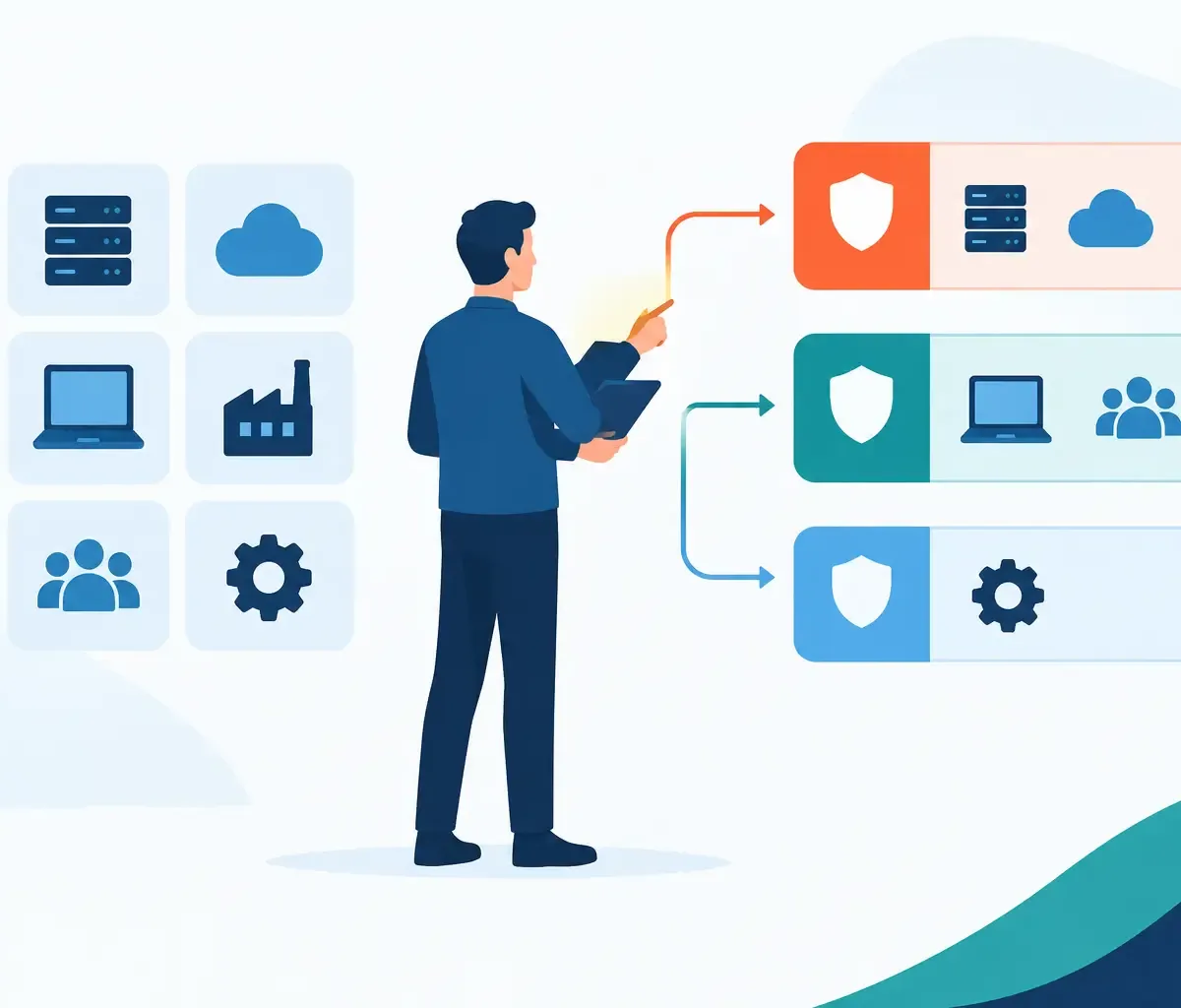
The most reliable way to classify critical assets is to work backwards from essential services. A payroll application, online citizen portal, manufacturing control process or clinical records service may each depend on dozens of technical components. The criticality of those components comes from their role in delivering the service, not from whether they are a laptop, virtual machine, cloud workload, database or identity platform.
Begin by identifying the services that the organisation cannot tolerate losing. Service owners should define the operational impact of a disruption, the maximum acceptable outage, any legal or contractual obligations, and the realistic consequences of compromised integrity or confidentiality.
This matters because availability is only one part of criticality. A system that remains online but serves altered data can be just as damaging. Likewise, an identity service may not generate revenue directly, but its failure can prevent staff and customers from accessing every dependent application.
For each service, establish a named business owner and a technical owner. If neither role can explain why the service matters, what it relies on, or how long it can be unavailable, the organisation does not yet have sufficient evidence to classify its assets confidently.
Define a classification model people can apply
A classification scheme should be simple enough to use consistently, but specific enough to drive different security and resilience decisions. Four tiers are usually sufficient:
- Critical: Failure or compromise causes unacceptable operational, safety, financial, legal or public-impact consequences. Recovery must be prioritised and controls must be closely assured.
- High: Disruption causes significant business impact but can be managed for a limited period through workarounds or delayed service.
- Moderate: The asset supports important activity, but its loss has contained impact and does not immediately stop a core service.
- Low: The asset has limited operational impact, can be replaced easily, or supports non-essential activity.
The labels matter less than the criteria behind them. A critical classification should require evidence rather than opinion. Use consistent questions: Does this asset support a time-sensitive service? Does it hold regulated, sensitive or safety-related data? Is it a shared dependency for multiple services? Would its compromise create a route to more valuable systems? Is there a tested workaround or a proven recovery path?
An internet-facing system with a severe exposure may require urgent action even if it is not business-critical. That is a separate question of current risk. Classification establishes enduring business importance; risk prioritisation combines that importance with exposure, weakness, threat and control effectiveness. Conflating the two is a common cause of inconsistent decisions.
Give shared dependencies the weight they deserve
Many of the most critical assets are not visible in business impact assessments because they sit underneath multiple services. Active Directory, Microsoft 365 identity, DNS, network core infrastructure, backup platforms, privileged access systems and cloud management planes are obvious examples. A failure in one can affect the whole organisation.
These shared services need a criticality uplift. A modest infrastructure component may appear low value when assessed in isolation, yet become critical when dependency mapping shows it is required by finance, operations, customer services and remote access. The same principle applies to third-party platforms and managed services. If an external provider is essential to a critical business process, include that dependency in the classification model and resilience planning.
Build the evidence from continuous visibility
A spreadsheet can record an asset classification, but it cannot prove that the classification remains accurate. Infrastructure changes. Cloud resources are created and removed. Devices move between networks. Users gain privileged access. A previously isolated application becomes internet-facing after a configuration change.
Effective classification needs a current inventory that brings together on-premises infrastructure, cloud environments, endpoints, network devices, identities, applications and service relationships. The aim is not another static list. It is a living view of what is connected, what it is doing, who owns it and what it supports.
Start by reconciling data from existing sources such as configuration management databases, cloud accounts, identity directories, vulnerability tools, network telemetry, endpoint platforms and service-management records. Expect disagreements. Those gaps are valuable evidence in themselves: they often reveal unknown devices, stale records, unmanaged cloud workloads or ownership failures.
Then map dependencies at a useful level of detail. You do not need to model every network packet before taking action. Identify the relationships that change a decision: which identity provider enables an application, which database holds its data, which network segment connects it, which backup service restores it, and which external service it cannot operate without.
Agentless and scanless intelligence can be especially useful where operational technology, legacy systems or sensitive environments cannot tolerate frequent scanning or additional endpoint agents. It can provide evidence without increasing deployment effort or introducing unnecessary operational risk.
Turn classification into different control requirements
Asset labels have little value if a critical system is managed in the same way as a low-impact one. Classification should directly shape the minimum assurance expected from owners and technical teams.
For critical assets, define tighter requirements for identity and privileged access, secure configuration, patch and vulnerability remediation, backup protection, logging, monitoring, incident response and recovery testing. Require named ownership, documented dependencies and a formal process for accepting residual risk. Where full remediation cannot happen within the required timescale, compensating controls should be explicit and time-bound.
High and moderate assets may follow proportionate versions of the same controls. The point is not to create a bureaucracy of forms. It is to reserve the strongest assurance activity for services where failure would cause real harm.
This is also where classification improves executive reporting. Leaders do not need another chart showing thousands of findings. They need clear answers: which critical services have unacceptable exposures, whether essential controls are operating, who owns the remediation, and what risk remains if action is delayed. A platform such as Rebasoft can bring asset, service, identity and control evidence together so those answers are based on current conditions rather than manual reporting cycles.
Review classifications when the business changes
Criticality is not permanent. An asset can become more important when a service moves online, a merger introduces new dependencies, a supplier changes, or regulation raises the consequences of data loss. It can become less important when a service is retired or a dependency is removed.
Review critical classifications at least annually, and trigger an earlier review after major architectural, business or regulatory change. Include them in change management for high-impact services. More importantly, monitor for conditions that challenge the original assessment: a new internet exposure, missing backups, a shift in privilege, an unapproved owner change or a newly discovered dependency.
There is a trade-off. Reclassifying every minor change wastes time and undermines confidence in the process. Waiting for an annual review leaves decisions based on outdated assumptions. The right balance is a scheduled review supported by continuous evidence and exception-based alerts.
Avoid the shortcuts that create false confidence
Several shortcuts repeatedly weaken asset classification. Treating all production assets as critical overwhelms teams and makes real priorities invisible. Using asset value or replacement cost alone ignores service dependency and data impact. Asking only IT to decide criticality misses operational, legal and customer consequences. Relying on one discovery source creates blind spots that attackers are quick to exploit.
Another mistake is treating the exercise as a one-off compliance task. Auditors may accept a register, but operational resilience requires proof that the register reflects the environment and that control decisions follow from it. Evidence should be available when needed, not assembled in a rush before an audit or board meeting.
The best classification programmes make uncertainty visible. If an owner is unknown, a dependency is unverified or a recovery capability has not been tested, record that as a risk to resolve. False precision is more dangerous than an honest gap.
A well-classified asset estate gives security teams permission to focus. It turns a long queue of technical findings into a defensible order of work: protect the services the organisation cannot afford to lose, prove the controls around them, and act quickly when the evidence changes.