A critical business service rarely fails because one team missed one alert. It fails because the organisation could not see how an exposed asset, a weak identity control, an unpatched system and a supplier dependency combined to interrupt an outcome the business depends on. Knowing how to prioritise business services means making those connections visible before an incident does it for you.
For security and IT leaders, this is not an exercise in producing another service catalogue. It is a way to direct finite people, budget and remediation capacity towards the services whose failure would cause the greatest harm. Done well, it gives leadership answers they can trust: what matters most, what is at risk, who owns the decision and what must be fixed first.
Start with the business outcome, not the technology
A business service is the outcome a customer, employee, citizen or regulator relies on. It may be processing payments, delivering patient care, managing customer access, operating a production line or meeting a statutory reporting deadline. The service is not simply a firewall, a server cluster or a Microsoft 365 tenant, although all may support it.
This distinction matters because technical severity alone does not establish business priority. A high-severity vulnerability on an isolated development system may need attention, but it is not automatically more urgent than a moderate weakness affecting the identity platform used to access payroll, clinical records or customer portals.
Begin by defining services in language the executive team and operational owners recognise. For each one, document the intended outcome, service owner, users, operating hours, acceptable downtime and recovery expectation. Keep the first pass practical. A precise view of the organisation's 20 or 30 most important services is more useful than an unmaintainable catalogue of every application.
How to prioritise business services using impact
The first priority is not always the largest service by revenue. Prioritisation should reflect the consequences of disruption, degradation, unauthorised change or data loss. A public-sector service supporting vulnerable people, for example, may have limited commercial value but an exceptionally high duty-of-care impact. A manufacturer may place safety and production continuity above short-term sales. A regulated financial organisation may treat legal and market obligations as non-negotiable.
Assess each service against a consistent set of impact dimensions. The most useful dimensions normally cover customer or citizen harm, safety, financial loss, regulatory exposure, contractual commitments, operational disruption and reputational damage. The question is not whether every impact can be converted into a perfect monetary figure. It is whether leaders can make a defensible comparison between services.
Use clear bands such as critical, high, medium and low, with written definitions. A critical service might be one where failure creates immediate safety concerns, prevents a legal obligation being met, stops a core revenue process or causes material harm within hours. The definitions should be agreed by business owners, not assigned by IT alone.
This creates an important discipline: a service may be technically complex yet not business-critical, while a seemingly simple identity, communications or data-sharing service may support many critical outcomes at once.
Map dependencies to find the real blast radius
Impact ratings only become actionable when they are connected to the assets, identities, data flows and third parties that deliver the service. This is where many programmes lose momentum. Teams hold application lists in one system, infrastructure records in another, vulnerability data in a third and control evidence in spreadsheets. No one can confidently show which issue threatens which service.
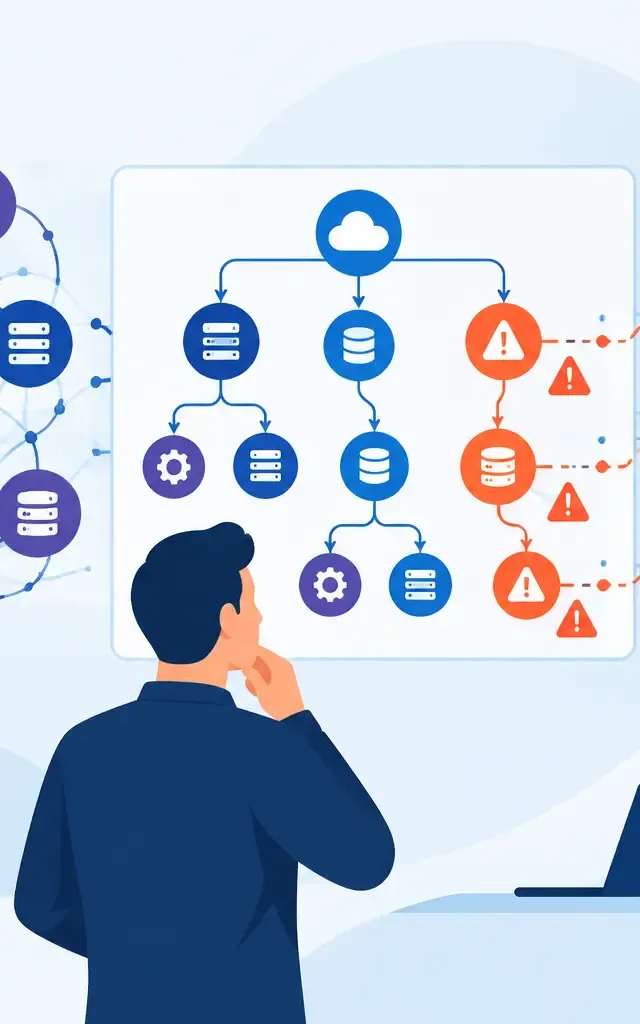
Build a dependency view from the service down. Identify the business applications, cloud subscriptions, on-premises infrastructure, network paths, privileged accounts, SaaS platforms, data repositories and suppliers that the service relies on. Then identify shared components. A domain controller, VPN, DNS service, privileged access platform or cloud identity tenant may underpin multiple services, making its failure far more significant than its individual asset record suggests.
Do not wait for a flawless configuration management database. Start with the evidence available, validate it with service and technical owners, and improve it continuously. Agentless and scanless discovery can help reveal assets and relationships that are missing from manually maintained records, particularly across hybrid estates and managed environments.
The aim is to answer a simple operational question: if this asset, account, control or supplier fails, which business services are affected and how quickly?
Combine criticality with current exposure
A critical service is not necessarily the service that needs the most attention this week. Priority comes from combining business impact with current exposure and the strength of available controls.
For example, a critical customer service with no known externally exposed assets, strong identity controls, tested recovery and current patching may require routine assurance rather than urgent intervention. Conversely, a high-priority service with a newly exposed remote access path, dormant privileged accounts and overdue recovery testing demands immediate action.
A workable decision model considers four questions:
- How serious would disruption, compromise or incorrect operation be?
- How exposed is the supporting environment right now?
- How effective are the controls that should prevent or limit the event?
- How quickly could the organisation detect, contain and recover from failure?
This avoids the common trap of treating CVSS scores, asset counts or compliance gaps as a complete measure of risk. Those indicators are useful, but they need business context. The vulnerability with the highest score is not always the vulnerability that presents the greatest risk to the organisation.
Assign ownership that leads to decisions
Every prioritised service needs a named business owner and a named technical owner. The business owner accepts the impact assessment and makes trade-offs when remediation affects cost, availability or delivery. The technical owner understands the dependencies, control state and recovery requirements. Security, risk and compliance teams provide challenge and evidence, but they should not be left carrying accountability for an outcome they do not own.
Ownership should be visible in the service record, alongside the last review date, outstanding risks and agreed actions. This reduces the familiar cycle in which a security team raises a finding, an infrastructure team disputes its relevance and no one decides whether the risk is acceptable.
For MSPs and MSSPs, the same principle applies across customers. A managed service provider needs customer-specific service criticality and ownership, rather than applying a generic severity rule to every alert. That is how managed assurance becomes an outcome-led service rather than a stream of technical tickets.
Turn priorities into a remediation queue
The output of service prioritisation should be a short, evidence-led action queue. It should show the issue, affected service, business consequence, accountable owner, required action and target date. If teams cannot see this relationship, they will revert to whichever dashboard creates the most noise.
The queue should distinguish between urgent fixes and resilience improvements. Closing an exposed administrative interface may be urgent. Removing unnecessary privileges, improving backup assurance or redesigning a fragile dependency may take longer, but can reduce recurring operational risk. Both matter, and both should be tracked against the service they protect.
Risk acceptance also has a place. Some weaknesses cannot be remediated immediately because of operational constraints, supplier dependencies or legacy technology. The answer is not to hide them in an exception register. Record the service impact, compensating controls, decision owner, expiry date and review point. That produces evidence for auditors and clarity for leadership.
Make prioritisation continuous, not annual
Business services change when organisations acquire businesses, migrate workloads, adopt SaaS, introduce automation or change suppliers. Their risk profile changes when new assets appear, identities gain privilege, controls drift or threat activity shifts. An annual business impact assessment cannot keep pace on its own.
Set a review cadence that reflects service importance. Critical services may need monthly operational assurance and quarterly business-owner review, while lower-priority services can be reviewed less frequently. Trigger a reassessment after major architectural change, a significant incident, a material audit finding or a change in regulatory obligation.
Continuous evidence is the difference between confidence and assumption. Rebasoft helps organisations connect asset, identity, vulnerability, configuration and service intelligence so teams can see what supports a critical service and what needs fixing first. The value is not another security dashboard. It is the ability to explain risk in terms of business outcomes, with evidence behind every decision.
The most useful test is simple: when a board member asks which three services need attention first, can the organisation answer with facts, owners and a clear plan? If not, the next priority is to build the service context that makes that answer possible.