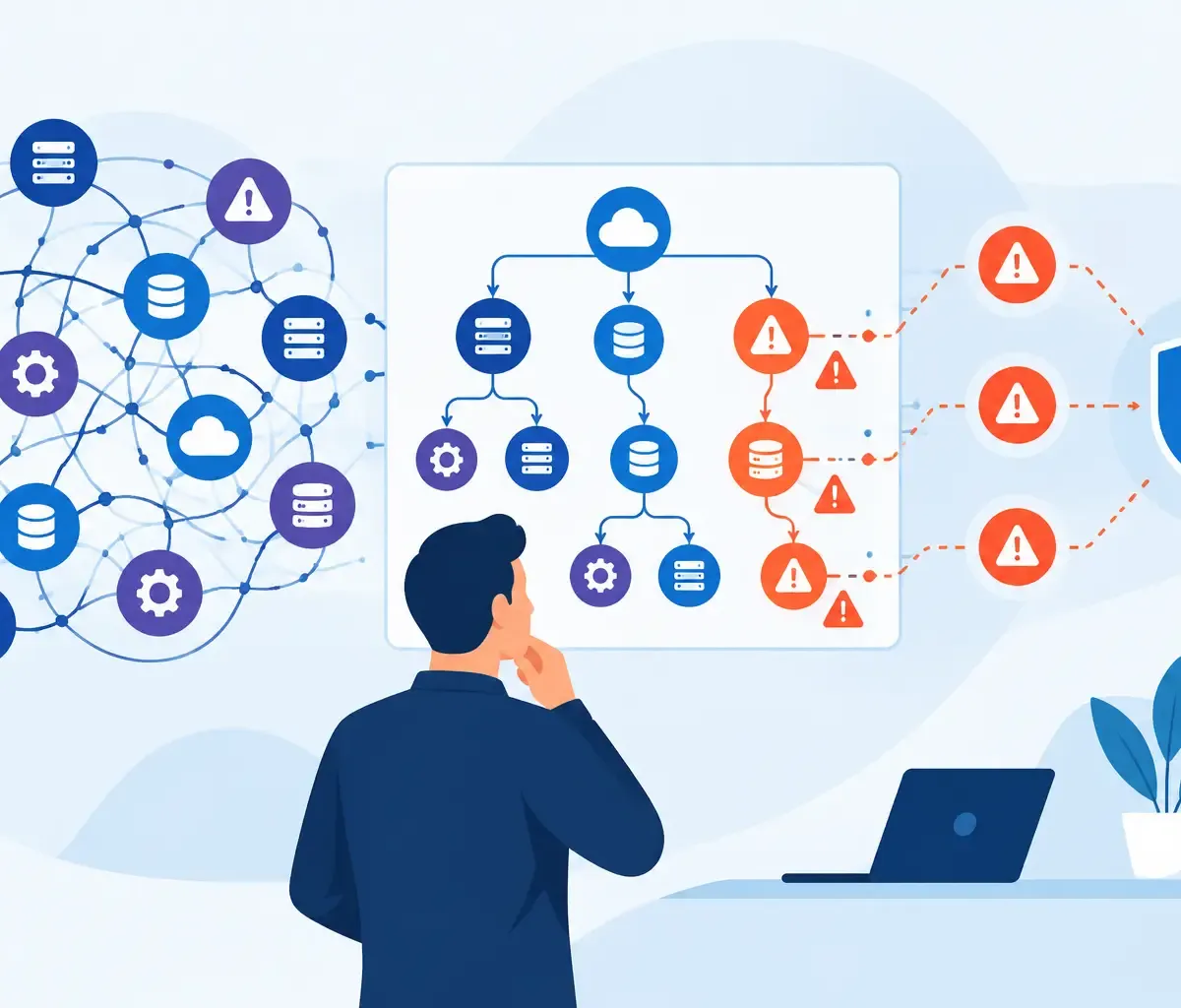
A critical vulnerability on an ageing server is not automatically a critical business risk. If that server supports a retired test environment, it may be less urgent than a seemingly minor configuration weakness in the identity service used by payroll, patient care, trading or citizen-facing applications. Service dependency mapping is what makes that distinction visible - and defensible.
For many organisations, the problem is not a shortage of alerts. It is the absence of context. Security, IT operations and compliance teams can each hold part of the picture: an asset inventory, a CMDB, cloud dashboards, vulnerability reports and service documentation. Yet few can answer, with evidence, which technical components support a critical business service and what happens if one of them fails or is compromised.
That gap slows incident response, distorts remediation priorities and leaves leadership receiving risk reports that describe technical exposure without explaining business consequence.
What service dependency mapping actually shows
Service dependency mapping connects a business service to the infrastructure, applications, identities, data flows and third parties it relies on. It moves the conversation from “what is vulnerable?” to “which important service is affected, who owns it and what should be fixed first?”
A useful map does not stop at an application name. It should reveal the chain of reliance beneath it: the cloud account or on-premises host, network route, database, identity provider, configuration baseline, integration and supporting operational process. It should also show where a dependency is shared. A single directory service, DNS platform, API gateway or privileged account can support dozens of services, turning an apparently local issue into a wider resilience concern.
This is different from a static architecture diagram. Diagrams are valuable, but they age quickly and are often created for a project rather than maintained as operational evidence. Dependency mapping needs to reflect the live estate, including changes introduced by cloud deployments, mergers, remote access, shadow IT and third-party connections.
Why technical severity is not enough
A high-severity finding deserves attention, but severity alone cannot decide the order of work. Teams must also consider exploitability, exposure, control coverage, service criticality and the consequence of interruption. Without that context, the loudest alert often wins.
Consider two issues. One affects an internet-facing workload supporting a revenue-generating customer portal. The other affects an internal device that is segmented, monitored and supports no critical service. Both may carry the same CVSS score. Their remediation priority should not be the same.
Service context gives security teams a credible basis for making those choices. It enables IT leaders to explain why a patch was expedited, why a lower-scoring finding was treated as urgent, or why a high-scoring issue is being managed through compensating controls until a maintenance window is available. This is not about accepting avoidable risk. It is about directing finite resource towards the risks that could cause the greatest operational, financial or regulatory harm.
The hidden dependencies that create outages
The most damaging dependencies are often the least visible. An application may appear healthy until a certificate renewal fails, a service account loses a permission, an identity platform becomes unavailable or a shared storage service reaches capacity. These issues sit outside the application team's immediate view, but can still stop the business service.
Mapping exposes these single points of failure before they become incident reports. It also reveals concentration risk: multiple critical services may depend on the same cloud tenant, administrator group, network appliance or outsourced provider. That knowledge changes resilience planning from broad assumptions to targeted action.
Service dependency mapping for cyber resilience
Cyber resilience depends on understanding how an attack could move from an exposed asset to a business outcome. Asset discovery identifies what is connected. Vulnerability management identifies weaknesses. Service dependency mapping establishes the potential path between the two and the services that path could disrupt.
That context strengthens several operational decisions. During triage, analysts can assess whether an exposed asset is linked to a critical service. During incident response, teams can identify likely downstream impact and the owners who need to be involved. During recovery, they can restore components in an order that brings priority services back safely rather than simply rebuilding systems as they appear in a ticket queue.
For regulated organisations, this also supports more mature impact analysis. A risk register stating that “servers are vulnerable” offers little assurance. A record showing that a particular exposure affects a service handling sensitive data, relies on a shared identity control and has no tested failover route is specific enough to drive ownership, remediation and governance.
Build a map that teams can trust
The goal is not to document every connection in exhaustive detail on day one. Trying to map the entire estate manually can become a long programme that delivers little immediate value. Start with the services where failure, compromise or non-compliance would matter most.
Begin by agreeing the business service, service owner, criticality and acceptable disruption. Then identify the components required for that service to operate: applications, hosts, cloud resources, data stores, network services, user groups, privileged identities and external suppliers. Confirm the relationships against live evidence, not only stakeholder recollection.
The most effective approach combines automated discovery with accountable human validation. Automation can identify assets, communications, configurations and identity relationships at scale. Service owners add the business knowledge: whether a dependency is essential, whether an alternative exists and what the real impact of loss would be.
A practical mapping process should answer four questions:
- What business service does this component support?
- What does the service depend on to operate securely?
- Which teams own those dependencies and their controls?
- What evidence shows the relationship is still current?
If the organisation cannot answer these questions for its most important services, it cannot reliably demonstrate resilience.
Avoid false precision
A dependency map can become misleading when it implies certainty that does not exist. Cloud services evolve, temporary integrations become permanent, and documentation often lags behind change. Treat mappings as living operational records rather than final artefacts.
It also matters to distinguish between a dependency that is technically present and one that is business-critical. A monitoring tool may communicate with an application without being required for the application to function. Conversely, an identity dependency may be indirect but essential. Capturing these differences prevents maps becoming crowded, difficult to interpret and ignored when decisions are needed.
Turn maps into prioritised action
The value of mapping comes from what happens next. Link each dependency to the risk and assurance information already used by operational teams: asset ownership, exposure, vulnerabilities, secure configuration status, identity posture, backup coverage and control evidence.
This creates a clearer remediation model. Teams can prioritise an issue because it affects a tier-one service, because it creates a shared point of failure, or because it weakens a control required for a regulated process. Leadership receives an explanation in business terms, with evidence behind it, rather than another unranked list of technical findings.
The same model reduces audit effort. Auditors and compliance teams frequently need proof that key services have appropriate controls, accountable owners and reviewed risks. When dependencies and control status are connected, evidence can be produced continuously rather than assembled manually at the end of an audit cycle.
For MSPs and MSSPs, this is particularly valuable across multiple customers. A managed service should not create more dashboards for customers to interpret. It should identify the services that matter, show where exposure is concentrated and demonstrate the work completed to reduce risk. That creates a more valuable assurance conversation and supports recurring, outcome-led services without proportionally increasing analyst workload.
Where a unified view changes the outcome
Fragmented tools make dependency mapping difficult because each tool describes only part of the environment. A CMDB may hold service names but not current asset relationships. A vulnerability platform may see exposures but not the service consequence. Cloud-native tools may provide detail inside one environment while missing the connections to on-premises systems and identity services.
A unified, agentless and scanless intelligence platform can reduce that fragmentation by bringing live asset, service, identity, exposure and control information into one operational view. Rebasoft helps teams establish this context without relying on another estate-wide agent deployment or adding a separate point product for each assurance task.
The trade-off is that no platform can replace service ownership. Technology can reveal connections and highlight inconsistencies, but business leaders and technical owners must agree what is critical, what disruption is tolerable and who is responsible for decisions. The strongest programmes make those accountabilities visible alongside the technical evidence.
When the next critical alert arrives, the useful question is not simply whether it is severe. Ask which service depends on it, what would fail if it became unavailable, and whether the organisation can prove its controls are working. That is where clearer priorities begin.