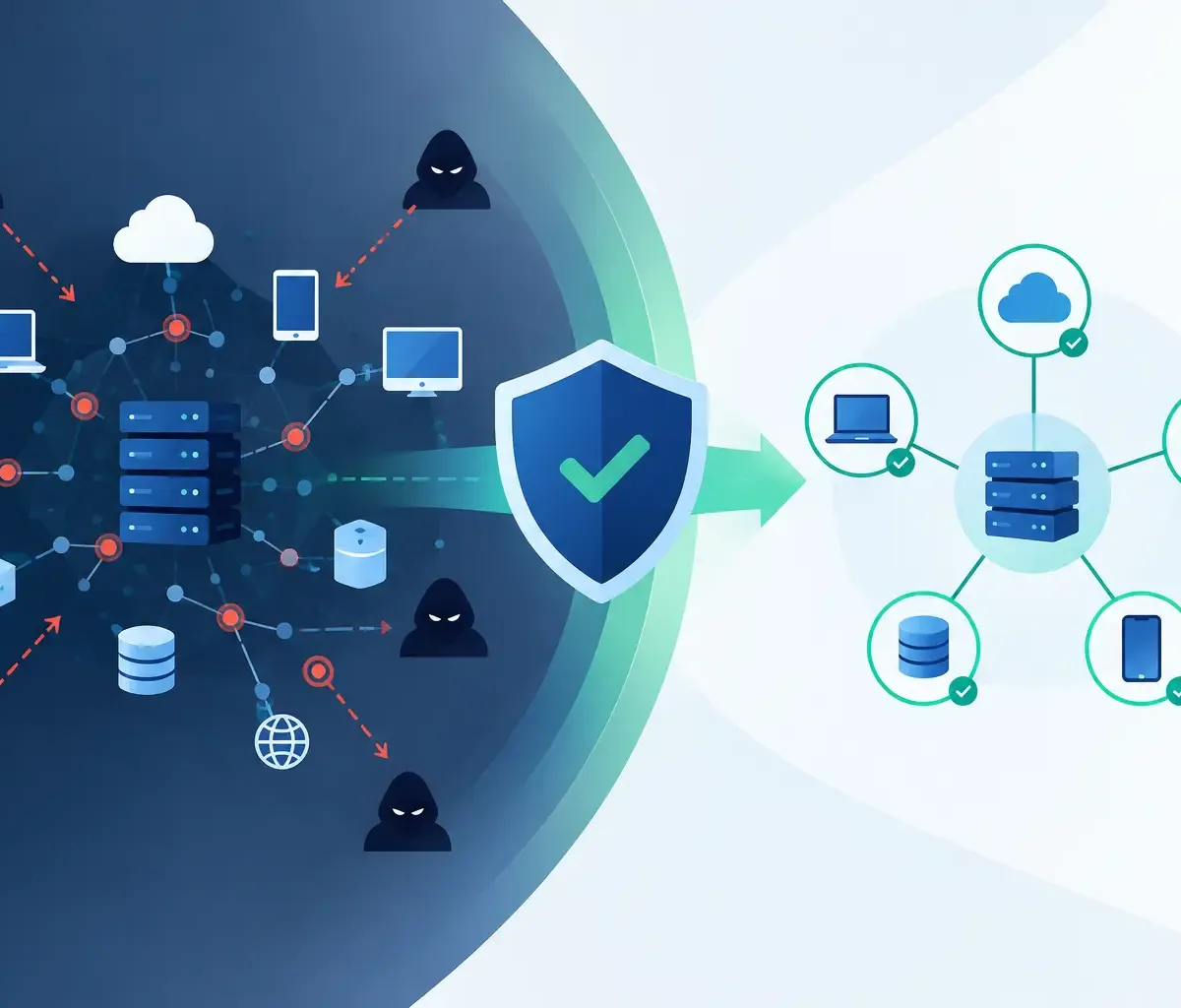
A growing attack surface is rarely caused by one dramatic failure. More often, it develops quietly: a cloud subscription is created outside the usual process, an administrator account remains active after a role change, a legacy server supports a critical service no one has formally mapped, or a configuration drifts from policy. Each gap creates uncertainty. Together, they make it harder to reduce cyber risk with confidence.
For security and IT leaders, the issue is not simply how many assets exist. It is whether they can see what is connected, understand what it supports, validate the controls around it and act on the risks that could disrupt important business functions.
What an attack surface really includes
An attack surface is every potential point through which an organisation can be accessed, disrupted or compromised. That includes internet-facing systems, cloud services, endpoints, network devices, applications, identities, privileged accounts, APIs, data stores and third-party connections. In operational technology environments, it can also include industrial control systems, management interfaces and remote access paths that have direct consequences for safety or service delivery.
The usual shorthand is to focus on exposed assets. Exposure matters, but it is only part of the picture. An unmanaged privileged identity with access to Microsoft 365, Azure or Active Directory may be more consequential than a publicly visible web server. A misconfigured cloud workload may be technically secure at the host level but still expose sensitive data through excessive permissions.
The attack surface also changes continuously. New services are deployed, users join and leave, suppliers connect, patches are delayed and configurations are altered. A spreadsheet-based inventory or a periodic vulnerability scan can provide useful evidence, but neither is enough to establish ongoing assurance.
Why asset lists do not provide enough assurance
Most organisations have several sources of asset data: CMDBs, endpoint tools, cloud consoles, network management systems, vulnerability scanners and identity platforms. The challenge is that each source answers a different question, at a different time, and often with a different definition of what an asset is.
This creates familiar problems. Security teams see vulnerabilities without knowing whether the affected system supports a revenue-generating service. IT teams know a device is on the network but cannot confirm its owner, patch status or business relevance. Compliance teams spend days collecting screenshots and exports to demonstrate that a control was operating at a particular point in time.
An accurate inventory is necessary, but it does not explain risk by itself. Leaders need to know which assets are connected to critical services, which identities can change them, what external exposure exists and whether required controls are working. Without that context, prioritisation becomes a contest between the loudest alert and the most recent audit request.
The cost of treating every finding equally
A long list of critical vulnerabilities can look decisive, but severity scores alone do not determine business risk. A high-severity issue on an isolated test system may deserve less immediate attention than a lower-scoring configuration weakness affecting a service used by customers, clinicians, citizens or production teams.
The same principle applies to identity risk. An inactive account may not be urgent until it has privileged access, lacks multi-factor authentication and is linked to a critical application. Context turns technical information into an actionable decision.
This does not mean low-priority findings should be ignored. It means remediation should be organised around likelihood, exposure, privilege, exploitability and business impact. That approach helps teams protect important services first, while retaining evidence that lower-priority risks are being managed through an agreed plan.
Attack surface management is a continuous discipline
Effective attack surface management combines discovery, validation and prioritisation. It establishes a current view of assets, services, identities and controls, then continually tests whether that view remains accurate as the environment changes.
For regulated and high-consequence organisations, this has practical value beyond security operations. It supports resilience planning, audit preparation, insurance discussions and board reporting. Instead of presenting leadership with disconnected numbers - such as total assets, open vulnerabilities and patch percentages - teams can explain what is exposed, why it matters and what action is being taken.
A useful programme answers four connected questions:
- What is connected to the environment, including unmanaged or previously unknown assets?
- What services, data and business processes depend on it?
- Which vulnerabilities, configurations, identities or exposures create the greatest risk?
- Can the organisation prove that controls are operating and remediation is progressing?
These questions need consistent evidence, not a one-off assessment. The attack surface changes faster than an annual audit cycle, particularly across hybrid infrastructure, SaaS platforms and cloud estates.
Start with visibility, then add business-service context
The first requirement is broad, reliable discovery across on-premises infrastructure, cloud environments, endpoints, network devices and identity systems. Agentless and scanless approaches can be particularly valuable where deployment effort, operational sensitivity or estate complexity makes additional agents and repeated scanning impractical.
However, visibility is only useful when it is reconciled. Duplicate records, stale ownership data and conflicting asset names quickly undermine trust. Teams need a coherent view that can identify an asset, its configuration, its relationships and its owner, even when information originates from several technical sources.
The next step is service context. A database, virtual machine or user account should not be assessed in isolation if it supports a core business service. Mapping these dependencies makes it possible to distinguish a routine maintenance task from an issue that could interrupt a public service, delay a financial process or expose regulated data.
This is where many programmes lose momentum. Building a perfect service map for every asset can take too long. A more practical approach is to begin with the services that matter most: customer-facing platforms, core operational systems, regulated workloads and services with strict recovery requirements. Coverage can then expand in a controlled way.
Validate the controls that reduce exposure
A smaller attack surface is not achieved only by removing systems. It is also achieved by proving that security controls are configured and operating as intended. That includes secure configuration, patch compliance, encryption, access controls, multi-factor authentication, privileged account management, network segmentation and backup resilience.
Control validation should identify drift as it occurs. For example, a device may be compliant when it is deployed but become non-compliant after a software update, policy change or exception. Similarly, an account may be appropriate when granted access but become excessive when an employee changes role.
Continuous evidence reduces the manual burden on security, IT and compliance teams. It also improves the quality of conversations with auditors. Rather than reconstructing the past from spreadsheets and point-in-time reports, teams can demonstrate the control state, exceptions, ownership and remediation history.
Prioritise remediation by service impact
The strongest remediation process connects findings to accountable owners and clear outcomes. A security team can identify exposure, but the system owner may need to assess operational constraints, planned maintenance windows and compensating controls. Prioritisation must accommodate that reality without allowing high-risk issues to disappear into a backlog.
Good governance defines what happens when a critical issue affects a critical service. It sets response expectations, escalation routes and acceptable risk decisions. It also records why an exception exists, who approved it and when it will be reviewed.
This improves resilience as well as security. When a new vulnerability or active threat emerges, teams already understand which systems are exposed and which services could be affected. They can focus action where it will reduce the most risk, rather than starting with a broad and disruptive search for affected assets.
Give leadership evidence they can trust
Boards and executive teams do not need every technical detail, but they do need answers they can trust. They need to know whether critical services are protected, where material exposure remains, whether risk is reducing and whether the organisation can meet its regulatory and resilience commitments.
Useful reporting connects technical control data to operational outcomes. It can show the proportion of critical services with known dependencies, the number of high-risk exposures affecting them, remediation performance against agreed targets and outstanding risk accepted by accountable leaders. It should also reveal uncertainty. Unknown assets and unverified ownership are risks in their own right, not reporting inconveniences.
Rebasoft helps organisations and managed service providers bring these views together across assets, services, vulnerabilities, configurations and identities, without adding another disconnected dashboard. The objective is not more alerts. It is faster, better-supported decisions.
A manageable attack surface is not a static end state. It is the result of disciplined visibility, context and evidence applied every day. Begin with the services that cannot fail, establish what supports them and make every remediation decision traceable to reduced business risk.