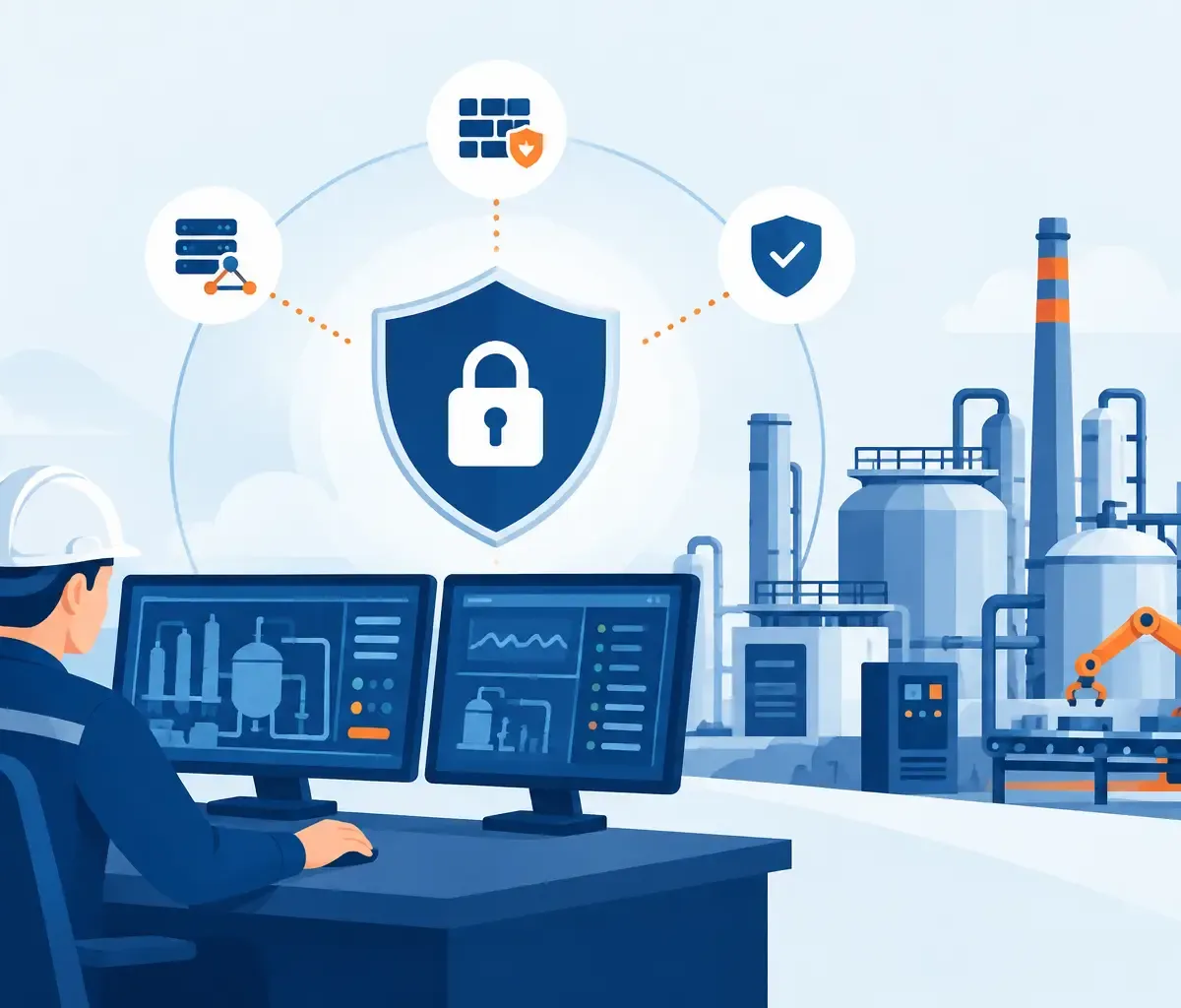
A production line can tolerate neither an unknown engineering workstation nor an indiscriminate security scan. This OT security guide is designed for leaders who must reduce cyber risk while protecting availability, safety and the services that keep operations moving.
Operational technology security is not simply enterprise IT security applied to a factory, utility, transport network or public-sector estate. The consequences of getting it wrong are different. A compromised business application may interrupt office work. A compromised programmable logic controller, historian, remote access gateway or building management system can affect physical processes, safety controls, regulated service delivery and public confidence.
The practical challenge is to establish control without creating another source of disruption. That starts with evidence: knowing what is connected, what it supports, who can access it, how it is configured and which weaknesses matter most to the operation.
Why OT risk needs business context
OT environments are built to run for years, often decades. Equipment may depend on legacy operating systems, specialist supplier software and protocols that conventional security tools do not understand well. Maintenance windows can be limited. Patching may require vendor approval, extensive testing or a planned shutdown that carries real commercial cost.
These constraints do not make security optional. They make prioritisation essential.
A vulnerability score alone cannot tell a security team whether a weakness should be addressed immediately. A moderately rated issue on a device that supports a critical water-treatment process, production cell or emergency communications service may deserve more attention than a high-severity finding on an isolated test system. Equally, a critical vulnerability may be less urgent where the asset is not exposed, access is tightly controlled and compensating controls are working.
Leadership needs answers that connect technical conditions to operational outcomes. Which services are at risk? What would disruption cost? Which control failures create a plausible path to a critical process? What action reduces risk without creating unacceptable downtime? This is the difference between a long list of alerts and a defensible OT security programme.
OT security guide: build visibility before enforcement
Many OT programmes begin with a network diagram that is already out of date. Assets are added during maintenance, supplier visits and local engineering work. Temporary connections become permanent. Remote access arrangements expand during an incident and remain in place long after it has closed.
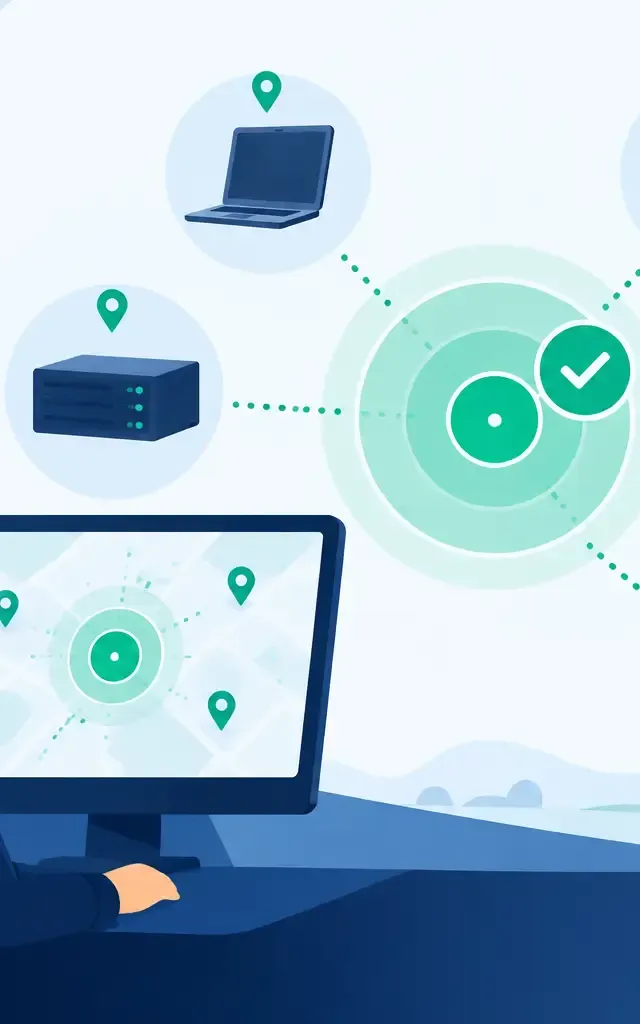
The first task is to create a continuous, trustworthy inventory. It should cover more than IP addresses and device names. For each asset, teams need to understand its role, owner, location, operating system or firmware, communications, software dependencies, access routes and the business service it supports. That includes industrial controllers, human-machine interfaces, engineering workstations, historians, gateways, firewalls, wireless equipment, virtual infrastructure and the identities used to administer them.
Passive discovery is often the safest foundation in sensitive environments because it observes network behaviour without placing load on devices. Existing network, identity and configuration data can add further detail without deploying agents to fragile endpoints. Active interrogation may still have a place, but it should be controlled, tested and agreed with operations teams before use.
Visibility must also expose change. A clean inventory on its own is useful, but a programme becomes far more effective when it shows a new remote access path, an unauthorised device, a changed controller configuration or a dormant privileged account becoming active. These are the events that turn an asset register into operational assurance.
Map assets to the services that matter
The most valuable OT security data is service-aware. A controller is not just a controller; it may support filling, pumping, environmental monitoring, train signalling or energy distribution. An engineering laptop may be the only approved route for updating a critical production process. If those dependencies are invisible, risk decisions are likely to be wrong.
Work with operations, engineering and service owners to identify critical services and map the systems that enable them. Keep the model practical. It does not need to represent every cable and process variable on day one. It needs to show enough dependency information to answer whether a device, account, network route or configuration change could affect a priority service.
This context helps teams decide where to invest. Network segmentation around a critical control zone, for example, may reduce more operational risk than a broad remediation exercise against systems with no direct connection to essential services. The goal is not perfect documentation. It is clearer decisions, supported by evidence.
Control access with the same care as the process
Remote support and privileged access are frequent pressure points in OT. Vendors need access to diagnose faults. Engineers need timely access during an outage. Yet shared accounts, always-on remote connections and unclear approval routes create unnecessary exposure.
A workable approach balances security with operational reality. Access should be attributable to named individuals, limited to the required systems, granted for an agreed period and reviewed regularly. Multi-factor authentication should protect remote entry points where technically feasible. Privileged accounts require particular scrutiny because their compromise can bypass otherwise sensible network controls.
Segmentation remains central, but it should be designed around real workflows. Flat networks make lateral movement easier; excessive segmentation can stop legitimate maintenance activity and encourage unsafe workarounds. Define communication paths between business IT, a controlled intermediary zone and OT networks. Then validate that firewall rules, remote access controls and administrative routes match the intended design.
Do not assume that a configuration standard is being followed because a policy says it should be. Check it continuously. A single unnecessary rule, enabled legacy protocol or exposed management interface can change the risk position materially.
Prioritise remediation without destabilising operations
Patching is necessary, but it is not the only response to OT vulnerabilities. Where a patch cannot be applied quickly, teams need credible compensating controls. These may include restricting network routes, removing unnecessary services, tightening remote access, monitoring high-risk communications, applying supplier guidance or increasing operational oversight until remediation is possible.
The key is to record the decision and its rationale. A deferred patch without an owner, expiry date and control evidence is not risk management. It is an unmeasured exception.
A useful remediation process brings security, OT engineering, service owners and change management together. For every significant finding, assess the asset's service criticality, exposure, exploitability, available maintenance window, vendor support position and existing controls. Agree the least disruptive action that reduces risk to an acceptable level, then verify that it has worked.
This discipline also prevents security teams from overwhelming engineers with generic findings. If the work queue is driven by business impact and achievable action, teams can fix the conditions that matter first and show why those decisions were made.
Prepare for disruption before it becomes an incident
OT incident response must account for safety, process continuity and the possibility that normal IT actions are unsuitable. Isolating a device immediately may be correct in one scenario and dangerous in another. Decisions should be agreed in advance, not improvised under pressure.
Plans should establish who has authority to stop or isolate a process, how engineers and security teams communicate, how supplier support is engaged, and where trusted configuration backups are held. Test the plan using realistic scenarios such as a compromised remote account, ransomware affecting an engineering workstation, loss of a historian or suspicious traffic crossing an OT boundary.
Recovery depends on more than backups. Teams need confidence that they can restore approved configurations, reconnect systems in the right sequence and prove that access paths and security controls are safe before returning to normal operations. Regular exercises expose gaps that documents alone will not reveal.
Make assurance continuous, not an audit scramble
Regulated organisations are often asked to demonstrate that controls exist, exceptions are managed and risks are understood. Manual evidence gathering consumes time and can produce a snapshot that is obsolete by the time it reaches an auditor or board committee.
Continuous evidence changes the conversation. Instead of reporting that a policy exists, teams can show which assets are in scope, which configurations meet the baseline, where privileged access is active, what vulnerabilities remain open and which critical services are affected. This improves audit readiness, supports cyber insurance discussions and gives leadership answers they can trust.
For MSPs and MSSPs, the same approach supports consistent service delivery across customer estates without multiplying tooling and analyst effort. A platform such as Rebasoft can bring asset, service, identity, configuration and vulnerability intelligence into one view, allowing partners to provide outcome-led assurance rather than another stream of disconnected alerts.
Measure progress in operational terms
The most useful OT security measures are not just counts of vulnerabilities or devices discovered. Track how quickly unknown assets are investigated, how many critical services have a validated dependency view, how much privileged access is time-limited, and how long high-priority exceptions remain open. Measure whether configuration drift is detected and resolved before it becomes an incident.
These measures make progress visible to both technical teams and executives. They also reveal where investment is needed: better asset intelligence, stronger access governance, more resilient network design or a more practical change process.
A safer OT environment is built through steady, evidence-led improvement, not a single technology purchase or annual assessment. Start with the service that would cause the greatest harm if disrupted, establish what supports it and make the next risk-reduction decision with confidence.