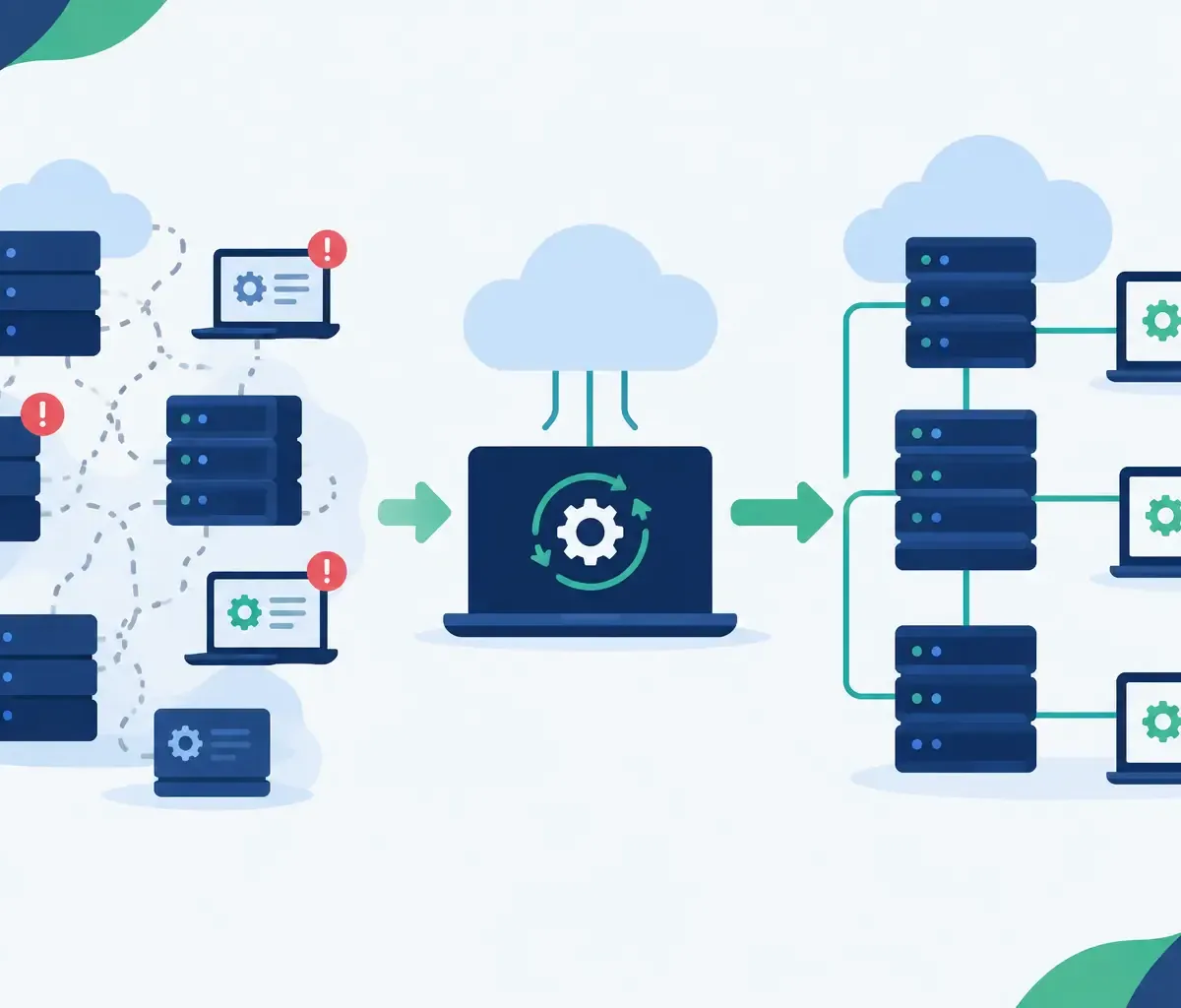
A firewall rule added during an incident, an expired privileged account left enabled, or a cloud storage setting changed for a short-term project can all create configuration drift. Each change may appear minor in isolation. Across a complex estate, however, they weaken controls, create audit gaps and expose critical services without anyone having made a conscious decision to accept that risk. Knowing how to remediate configuration drift means moving beyond periodic checks and restoring control continuously.
What configuration drift means in practice
Configuration drift occurs when systems move away from their approved, secure or operationally required state. It affects on-premises infrastructure, cloud platforms, identity systems, end-user management, containers, network devices and software-as-a-service environments.
The source is not always poor practice. Emergency changes are necessary. Teams may adjust access to restore a business service, deploy a workaround to meet a deadline or inherit settings from a new acquisition. Drift becomes a material issue when those changes are not assessed against policy, tied to an accountable owner, or reversed when the need has passed.
A monthly compliance report can reveal that a control was missing. It cannot necessarily tell you when the drift began, which service became exposed, whether a compensating control existed, or whether the issue has already been fixed. That distinction matters to security leaders, auditors and boards. The question is not simply whether a configuration differs from a baseline. It is whether that difference increases risk to an important business function.
How to remediate configuration drift without creating disruption
Effective remediation follows a controlled operational process. The aim is to reduce cyber risk quickly while avoiding a second outage caused by an ill-considered change.
Establish the approved state first
You cannot identify drift reliably if the desired state is vague, outdated or stored in different spreadsheets and team folders. Define the controls that matter for each asset class and environment. These may include secure configuration standards, access policies, firewall rules, encryption requirements, patching configurations, logging settings and cloud guardrails.
Not every system needs the same baseline. A production database supporting a public service should have different tolerance for change than a development environment. Equally, a legacy application may need an approved exception while a replacement is underway. Record the exception, its owner, the business reason, compensating controls and a review date. An undocumented exception is drift with a better explanation, not a managed risk.
Build a complete view of the estate
Remediation fails when visibility is partial. An endpoint management platform may see laptops but not network equipment. A cloud-native tool may identify misconfigurations in one subscription but miss identity dependencies, connected services or on-premises assets.
Start with an authoritative inventory of what is connected and what role it performs. Map assets to owners, services, environments and data sensitivity wherever possible. This turns a finding such as “logging disabled” into a decision: logging is disabled on a server that supports a revenue-generating application, has internet-facing dependencies and processes sensitive data.
Agentless, scanless intelligence can be particularly valuable where estates are distributed, regulated or operationally sensitive. It reduces reliance on teams deploying yet another endpoint component or scheduling intrusive scans simply to establish what has changed.
Detect change continuously, not only at audit time
Drift is a moving target. Point-in-time assessments are useful for certification and reporting, but they leave long periods in which an unauthorised or unsafe change can remain unnoticed.
Continuous monitoring should compare observed configurations with approved baselines and known exceptions. It should also retain a clear history: what changed, when it changed, who owns the asset and whether the change aligns with an approved request. This evidence gives operations teams a faster route to diagnosis and gives compliance teams a defensible record without extensive manual collection.
The practical test is straightforward. When a high-risk configuration changes at 10.00 on Tuesday, can the right team identify it, understand the affected service and act before the next reporting cycle? If the answer is no, detection is not operating at the speed of the business.
Prioritise remediation by service impact
A long list of deviations is not a remediation plan. Treating every misconfiguration as equally urgent overwhelms teams and encourages alert fatigue. Prioritisation should combine the severity of the control failure with exploitability, asset exposure, data sensitivity and business-service dependency.
For example, an insecure protocol on an isolated test device may warrant planned remediation. The same setting on a gateway supporting clinical systems, payment processing or citizen services may require immediate containment and executive visibility. Context also prevents wasted effort. A setting that differs from policy may be an approved temporary exception, while an apparently minor identity configuration could provide a path to widespread privilege escalation.
This is where configuration assurance should sit alongside vulnerability, asset and identity intelligence rather than operate as another isolated dashboard. Rebasoft helps organisations and managed service providers connect control failures to the services and risks that leadership needs to understand.
Make the correction safely and prove it worked
Remediation is more than applying a setting. Confirm the proposed change with the service owner, assess dependencies, obtain the appropriate approval and use controlled deployment methods. For high-consequence systems, test the corrected configuration in a representative environment first and ensure there is a rollback plan.
After implementation, validate that the configuration now meets the required state and that the business service remains available. Capture evidence of the original deviation, the decision, the person accountable, the corrective action and the validation result. This closes the loop for auditors and avoids the familiar cycle of reopening the same finding because nobody can prove what happened.
A practical operating model for drift remediation
The most effective programmes make configuration assurance part of normal service management, not a quarterly scramble. A workable model has four connected stages:
- Detect deviations against approved baselines and authorised exceptions.
- Assess risk using exposure, identity, vulnerability and service context.
- Assign an accountable owner with a clear remediation timeframe.
- Validate the correction and retain evidence for operational and audit use.
Ownership is often the weak point. Security teams may identify the issue, infrastructure teams may hold the technical access and application owners may understand the service impact. Establish decision rights in advance. Security should define the control objective and risk threshold; operational teams should implement and validate changes; service owners should accept or challenge any exception based on business need.
Service level targets should reflect risk. A critical internet-facing deviation should not enter the same queue as a low-risk configuration tidy-up. Where immediate correction would jeopardise availability, apply compensating controls, document the risk decision and set a short review date. This is not a reason to defer action indefinitely. It is a way to make a conscious, evidenced trade-off.
Common remediation mistakes
The first mistake is chasing compliance scores without understanding material risk. A high percentage of compliant assets can still conceal one exposed system supporting a vital service. Measure coverage, but focus leadership reporting on the exceptions that affect resilience, regulatory obligations and business operations.
The second is relying on manual evidence gathering. Screenshots, spreadsheets and ticket updates may satisfy a single audit request, yet they consume skilled time and quickly become stale. Continuous evidence reduces the effort required to demonstrate that controls are working between audits, not just before them.
The third is treating automation as a substitute for governance. Automated correction is valuable for low-risk, repeatable changes such as enforcing approved endpoint settings. It is less appropriate where a change could interrupt a legacy application, operational technology environment or specialist service. Automate detection and routine fixes, but keep informed human approval where impact demands it.
Finally, do not measure success only by the number of closed tickets. Better measures include the time taken to detect high-risk drift, the age of unapproved exceptions, the percentage of critical services covered by approved baselines and the reduction in audit evidence effort. These show whether the organisation is becoming easier to defend and easier to operate.
Turn drift control into lasting assurance
Configuration drift will never disappear entirely because infrastructure, users and business priorities change constantly. The objective is not to freeze the estate. It is to make every meaningful deviation visible, assessed, owned and evidenced.
When teams can see what changed, understand which service is affected and prove the corrective action, configuration management becomes more than a technical hygiene exercise. It becomes a practical source of resilience and gives leadership answers they can trust when risk, insurance readiness or audit scrutiny increases.