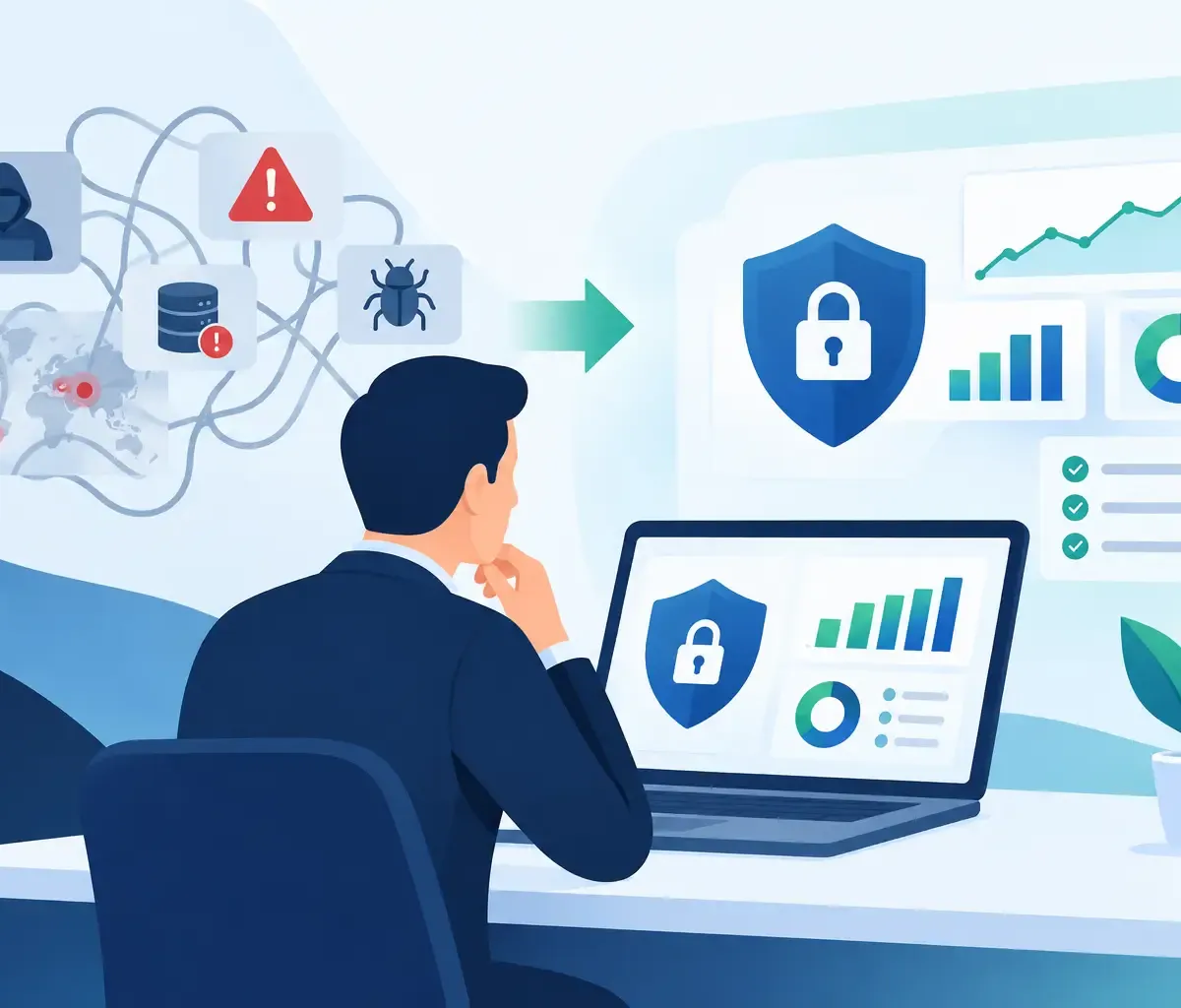
A board report that says there are 14,000 vulnerabilities, 37 unmanaged devices and 92 failed controls does not answer the question leadership actually needs answered: which business services are at risk, and what should be fixed first? The best cyber risk reporting tools turn technical findings into accountable decisions, backed by evidence that security, IT, audit and the board can trust.
For regulated, high-consequence and resource-constrained organisations, reporting is not a presentation task at the end of the month. It is the mechanism that connects asset visibility, control performance, exposure and remediation to business priorities. If the underlying data is incomplete or the context is missing, a polished dashboard simply makes uncertainty look more professional.
What cyber risk reporting must achieve
A useful reporting platform should help different audiences make better decisions without creating separate versions of the truth. Security teams need to see exposure, ownership and remediation progress. IT operations need actionable work aligned to the services they support. Compliance teams need evidence that controls are operating. Leadership needs a clear view of material risk, trend and investment priorities.
That requires more than importing vulnerability scores into charts. A critical vulnerability on an isolated test machine is not equivalent to a lower-scoring weakness affecting an identity service, clinical application, payments platform or operational technology environment. Reporting must account for the asset, the business service it supports, its exposure, the control gaps around it and the feasibility of remediation.
The strongest tools also make the evidence traceable. When an auditor, insurer or executive asks why a risk was rated as material, the team should be able to move from the headline to the affected service, assets, configuration state, identities and corrective actions. Manual spreadsheet reconciliation cannot provide that level of assurance at scale.
The main types of cyber risk reporting tools
There is no single category that suits every organisation. The right choice depends on whether the immediate problem is governance, technical exposure, control assurance or fragmented operational data.
GRC platforms
Governance, risk and compliance platforms are designed to manage risk registers, policies, control libraries, assessments, attestations and audit workflows. They are valuable where formal accountability and regulatory mapping are central requirements.
Their limitation is often data freshness. Many GRC deployments still rely on surveys, manual evidence uploads and periodic assessments. They can document a risk exceptionally well while offering limited proof of what is currently connected, exposed or misconfigured. A GRC platform works best when it receives continuous technical evidence from operational systems.
Vulnerability and exposure management platforms
These tools identify weaknesses, prioritise vulnerabilities and often add threat intelligence or external attack-surface data. They can be highly effective for reducing exploitable exposure, particularly when teams have mature patching processes and a well-maintained asset inventory.
The trade-off is that their reports may remain vulnerability-led rather than service-led. CVSS scores, exploitability and internet exposure matter, but they do not automatically show whether a finding affects a business-critical process or whether compensating controls reduce the real-world risk. They should inform risk reporting, not define it alone.
Security analytics and SIEM reporting
SIEM and security analytics tools provide valuable reporting on events, detections and response activity. They answer questions about suspicious behaviour, attack patterns and incident handling. For security operations centres, this is essential.
However, event reporting is not the same as cyber risk reporting. A quiet SIEM does not prove that assets are known, privileged access is controlled or secure configuration is being maintained. Organisations should avoid treating detection coverage as a complete measure of cyber assurance.
Integrated cyber assurance platforms
An integrated platform brings together discovery, asset and service intelligence, vulnerability and configuration evidence, identity visibility, compliance assurance and risk reporting. This model is most useful when the core challenge is fragmentation: different tools report different asset numbers, control status is difficult to validate, and teams cannot connect technical issues to business impact.
Rebasoft is an example of this approach, providing agentless and scanless intelligence that can establish continuous evidence across hybrid environments and present risk in the context of the services that matter. For organisations trying to consolidate overlapping tools, this can reduce both reporting effort and gaps in assurance.
How to assess the best cyber risk reporting tools
Do not start with dashboard design. Start with the decisions the organisation struggles to make. If leadership cannot determine whether a critical service is adequately protected, the platform must connect that service to its supporting infrastructure, identities, controls and known weaknesses.
Assess prospective tools against four practical tests:
- Coverage: Can the platform identify assets, identities, cloud services, on-premises infrastructure and dependencies without creating another manual inventory exercise?
- Context: Can it distinguish a technical finding from a business-critical risk by showing service ownership, criticality, exposure and control status?
- Evidence: Can teams demonstrate how a risk rating was reached, retain a history of changes and produce audit-ready proof without a separate evidence chase?
- Action: Can the report assign ownership, prioritise remediation and show whether actions reduced risk over time?
A fifth test is deployment reality. A platform that requires agents on every endpoint, lengthy tuning or major data-cleaning projects may be appropriate in some environments, but it delays time to value. Public-sector bodies, distributed enterprises and managed service providers should consider how quickly the tool can establish a credible baseline and how much specialist administration it demands thereafter.
Reporting for the board without oversimplifying risk
Board reporting should be concise, but it must not be vague. Traffic-light charts are useful only when their criteria are defined and defensible. A red status should mean something measurable, such as a material service operating with unmitigated critical exposure, an unsupported technology dependency or a control failure beyond the organisation’s agreed tolerance.
A strong board pack normally shows the current risk posture, movement since the previous period, the services most exposed, remediation progress and decisions required from leadership. It should also explain confidence in the underlying data. If part of the estate is not visible, say so. Uncertainty is a risk condition, not an inconvenience to hide in an appendix.
Avoid reporting a single cyber risk score as though it were a financial statement. A score can be useful for trend analysis, but it should sit alongside the drivers behind it. Leaders need to know whether risk is improving because high-impact issues were genuinely resolved, or because the measurement scope changed.
What good operational reports look like
Operational reporting needs greater detail than board reporting, but it should still be prioritised. A remediation team does not benefit from a flat list of every weakness in the estate. It needs a queue that identifies the affected service, asset owner, risk rationale, available mitigation and deadline.
For example, rather than reporting 600 missing patches, a useful report might show that 18 patches affect internet-facing systems supporting a customer portal, six are associated with known exploitation, and four systems lack a named owner. That statement creates a route to action. It also reveals whether the obstacle is patching capacity, asset ownership, change control or a deeper service dependency.
The same principle applies to secure configuration and identity risk. A report on hundreds of deviations is less valuable than one that identifies which deviations weaken privileged access to critical services, where the control failed and what evidence confirms the fix.
The hidden cost of fragmented reporting
Many organisations already own enough tools to generate reports. Their problem is that each tool reports a different slice of reality. Asset discovery, vulnerability management, cloud security, endpoint management, identity governance and compliance systems may all contain useful data, but reconciling it consumes skilled time and creates conflicting numbers.
This has a commercial impact. Analysts spend time assembling slides instead of reducing risk. Audits trigger evidence-gathering exercises. MSPs and MSSPs struggle to give every customer a consistent view without increasing staffing. Meanwhile, leadership receives reports that are technically detailed yet unable to prove whether investment is reducing exposure.
Tool consolidation should not mean forcing every security function into one product. Specialist tools retain value where they provide depth that the organisation genuinely uses. The goal is to establish one dependable reporting layer that can connect the evidence, apply business context and expose gaps before they become audit findings or incidents.
Choose for confidence, not dashboard volume
The most attractive demonstration is not always the most useful platform. Ask vendors to show a real reporting journey: a business service, the assets and identities supporting it, the exposure or control failures affecting it, the accountable owner, and the evidence that remediation improved the position. If that journey requires several exports and manual explanation, the reporting capability is not yet doing its job.
Choose the tool that gives leadership answers they can trust and gives operational teams a clear next action. When reporting is grounded in continuous evidence and business-service context, it becomes a practical control in its own right: one that helps the organisation reduce cyber risk before a technical issue becomes a business failure.